Design Paper 002 The T Bar Across Time
A design study in continuity, proportion and quiet permanence, examining how one Sampson Mordan T-bar pendant can move across past, present and future without losing its character.

The Brief
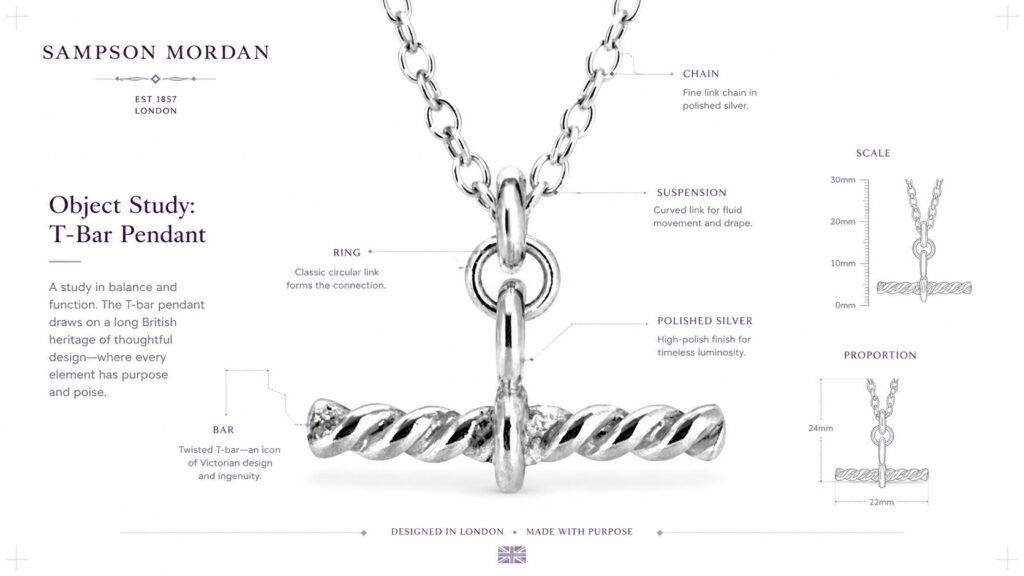
The brief was to test whether a single Sampson Mordan object could carry the house identity across time. The chosen object was the T-bar pendant: a simple silver form made from bar, ring, chain and suspension.
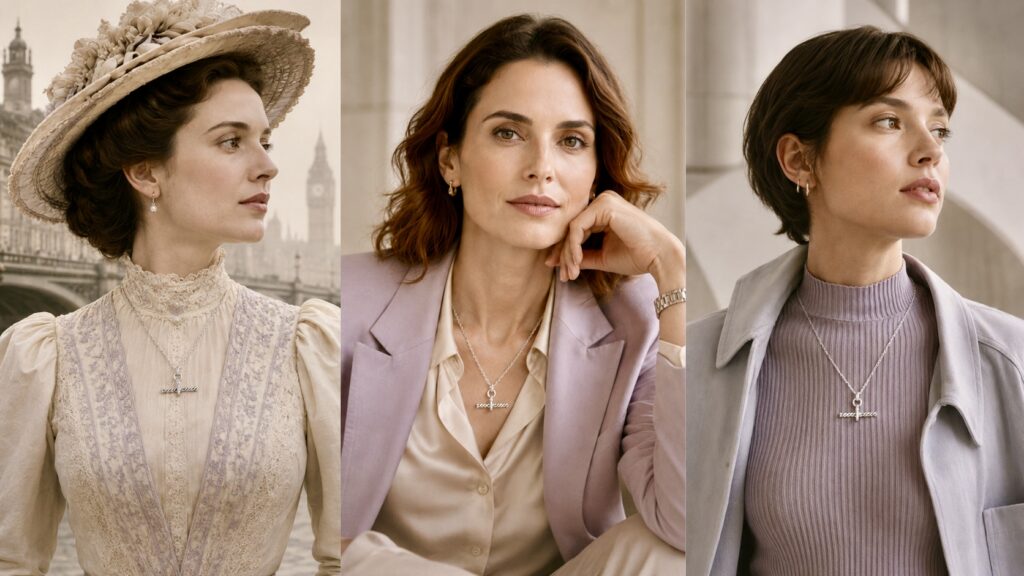
The image study places the same pendant across three women, each representing a different visual register: past, present and future. The purpose is not to suggest that the pendant itself is an archive piece, or that this exact design has been worn continuously through history. It is a contemporary study in how a well-resolved object can move between eras while retaining its own character.
The question behind the work was direct:
Can a new object feel as though it belongs to a longer house story without pretending to be old?
The Design Tension
The central tension was between historical memory and present use. Sampson Mordan carries a language of useful precious objects, silverwork, chains, mechanisms, carried pieces and personal accessories. A contemporary pendant must be able to acknowledge that world without becoming costume.
The T-bar was chosen because it sits between function and adornment. It suggests fastening, suspension and connection, but becomes jewellery through proportion, polish and placement against the body. It is recognisable without being decorative for decoration’s sake.
That made it an ideal subject for a design paper. The form is simple enough to cross time, but specific enough to carry meaning.
The Object
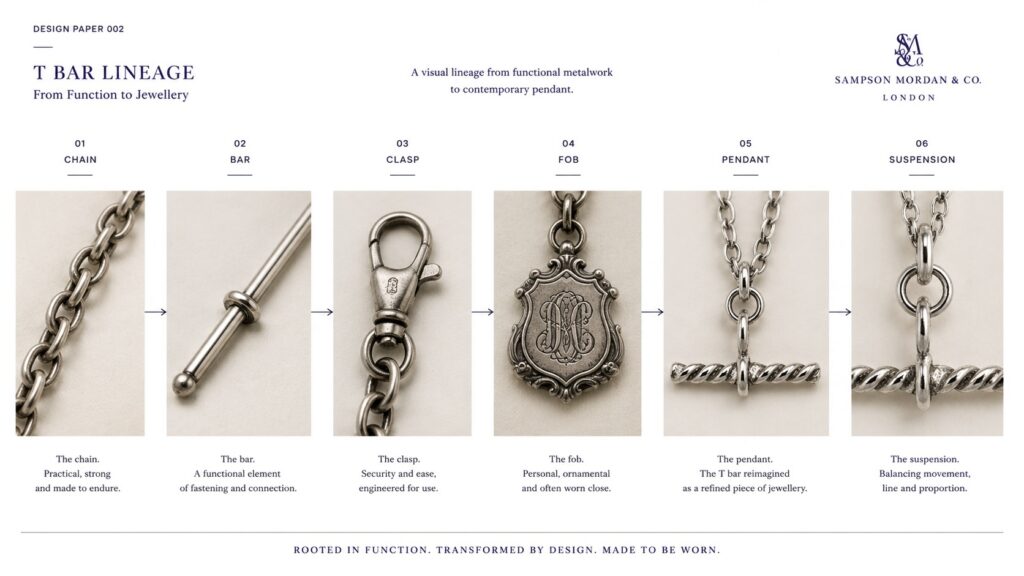
The pendant is built from a small number of elements: a horizontal bar, a central ring, a vertical suspension link and a chain. Its strength comes from this clarity. Nothing is over-explained. Nothing relies on excess ornament.
The bar gives the piece its line. The ring gives it movement. The chain gives it wearability. The polished silver gives it light.
In this sense, the pendant behaves almost like a small architectural object. It has structure, axis, balance and function. It is jewellery, but it retains the memory of hardware, fastening and use.
The Principle
The design principle for the study is:
The object changes context, not character.
This line governs the whole visual treatment. Across the three portraits, the clothing, period reference, palette and setting change. The pendant does not. Its role is to remain constant: a quiet centre point in silver.
That is the reason the object works. It does not need to become more historical for the past image, more commercial for the present image, or more futuristic for the future image. Its restraint allows it to travel.
The Past
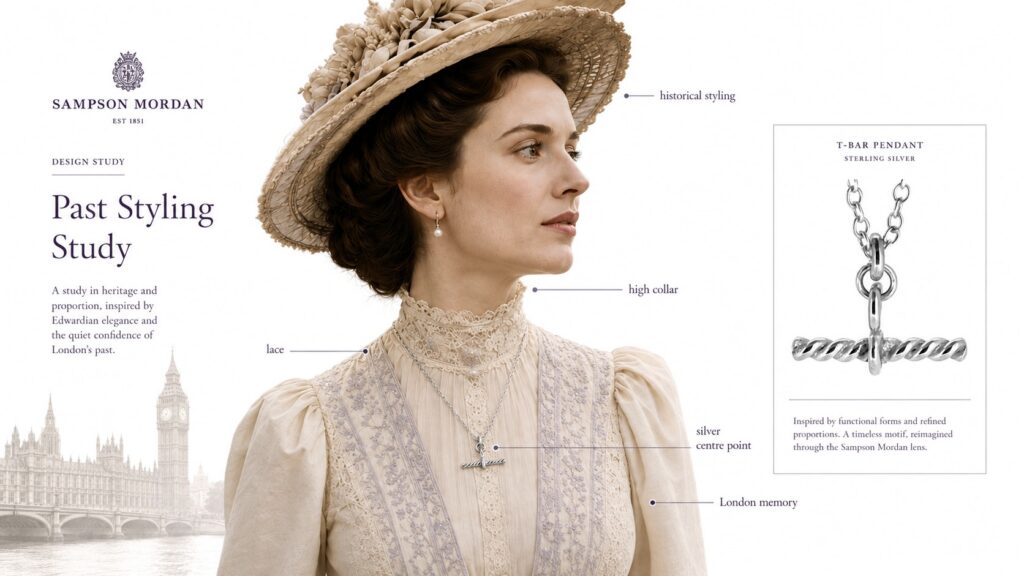
The first figure places the pendant into a historic visual register. The styling uses pale fabric, lace, a high neckline and an atmosphere of London memory. The pendant sits at the centre of the composition as a small silver object against soft dress.
This is not presented as a literal historical claim. Instead, it is a visual test. The question is whether the form can sit naturally within the world of historic dress, formal presentation and worn silver.
It can, because the T-bar has an inherent relationship with chains, suspension and personal objects. Its design language feels functional before it feels fashionable. That gives it permission to sit within a past-facing image without appearing forced.
The Present
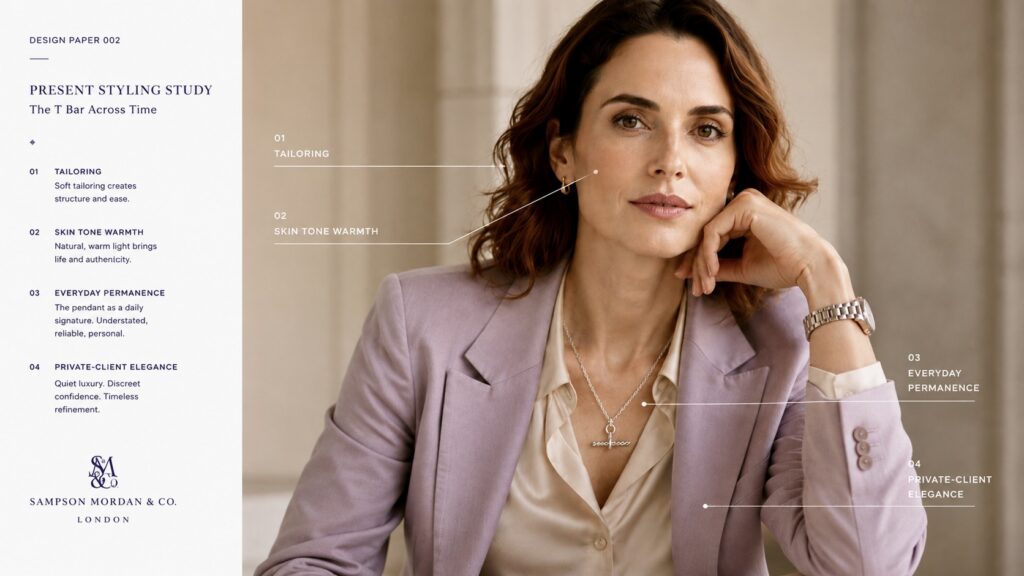
The second figure brings the pendant into the present. The styling is contemporary but calm: soft tailoring, natural skin tone, warm light and a composed expression. The pendant becomes part of an everyday language of permanence rather than a statement piece.
This is important for Sampson Mordan. The object should not feel dependent on theatrical styling. It should work with a silk blouse, a jacket, a shirt, knitwear or evening dress. The jewellery must carry enough character to be noticed, but enough restraint to be worn often.
Here, the T-bar acts as a modern personal object: familiar, polished and quietly distinctive.
The Future
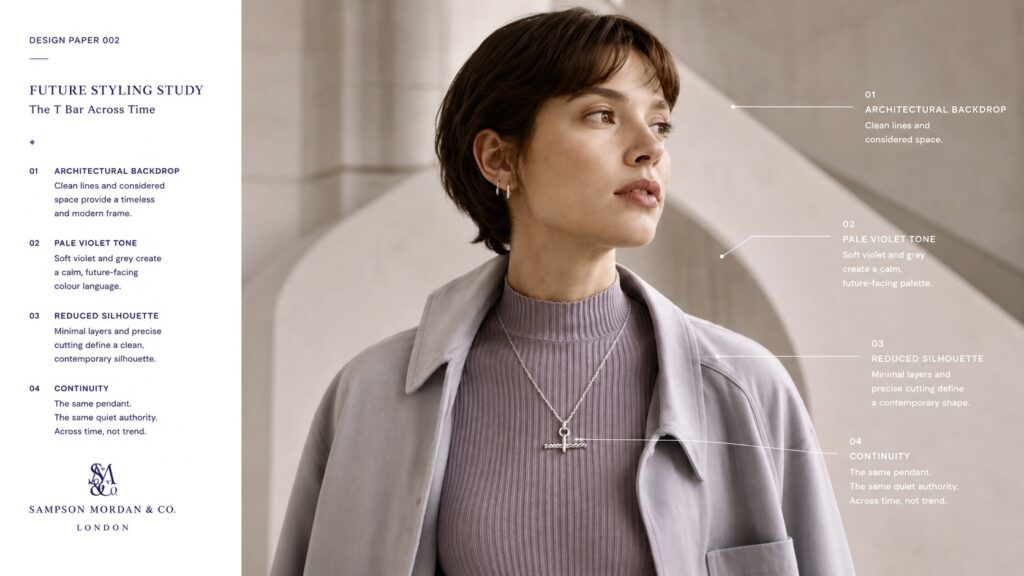
The third figure looks forward, but deliberately avoids science fiction. The future is treated as a quieter, cleaner version of continuity: pale tones, architectural backdrop, reduced styling and a sharper silhouette.
The pendant remains readable because its form is not trend-led. It does not belong to a single season. It belongs to a way of wearing: silver against the body, proportion held in balance, detail reduced to what matters.
This is the future Sampson Mordan should aim for. Not novelty, but endurance.
Past Present Future
The triptych works because the three portraits are not trying to create three different products. They are testing one object against three different contexts.
In the past image, the pendant feels connected to memory. In the present image, it feels personal and wearable. In the future image, it feels reduced and permanent. The form holds in each case because it is neither over-designed nor anonymous.
That balance is central to the house language. Sampson Mordan should not need to choose between historic reference and contemporary clarity. The strongest objects can carry both.
The Visual System
The image uses a soft pastel palette to avoid heaviness. Cream, ivory, pale lilac, wisteria and silver tones give the composition a feminine atmosphere without making the pendant feel fragile. The jewellery remains the consistent point of light across all three panels.
The triptych format is also significant. It gives the study a clear rhythm: before, now and next. The vertical divisions create order, while the repeated pendant creates continuity.
The result is not simply a campaign image. It is a visual argument.
The Jewellery Logic
The T-bar pendant is effective because it carries several ideas at once. It is a bar, but also a line. It is a fastening form, but also an ornament. It is simple, but not empty. It is small, but it has presence.
That makes it well suited to Sampson Mordan. The house language should favour objects with purpose, proportion and material clarity. The pendant does not need elaborate symbolism. Its meaning comes from how it is made, how it is worn and how it sits within the broader world of silver, chains and personal objects.
Applications
This design study can support several uses across the house identity:
- journal and design paper editorial features
- product storytelling for the T-bar pendant
- social media campaign imagery
- homepage or collection landing page visuals
- printed product cards and presentation material
- future campaign direction for women’s jewellery
The strongest use is editorial. The image should not be treated only as a product shot. It should be used to establish the emotional and historical range of the object.
Why This Matters
A new house object has to do more than look attractive. It has to explain why it belongs. The T-bar pendant belongs because it draws from a language of function, suspension, silver and personal wear. It does not need to claim an invented archive. It carries enough design logic to stand on its own.
The past, present and future study gives that logic a visual form. It shows that the pendant can sit with historic dress, modern tailoring and future-facing simplicity without changing itself.
That is the mark of a useful design.
House Note
The Sampson Mordan T-bar pendant is a contemporary object with a longer visual memory. It is not presented as a reproduction, nor as an archive revival. It is a present-day house piece shaped by proportion, material, restraint and the enduring appeal of useful silver forms.
The object changes context, not character.
Frequently Asked Questions
What is the Sampson Mordan T-bar pendant?
The Sampson Mordan T-bar pendant is a silver pendant necklace built around a horizontal T-bar form, suspended from a ring and chain. Its design language draws from structure, connection and functional metalwork.
Is the T-bar pendant an original historic Sampson Mordan design?
This design paper does not present the pendant as an original historic Sampson Mordan archive design. It is treated as a contemporary house object informed by a broader language of silver, chains, suspension and personal accessories.
What does the past, present and future image represent?
The triptych is a visual study showing how the same pendant can move across three styling registers: historic, contemporary and future-facing. It is a design test rather than a literal timeline.
Why is the T-bar form important?
The T-bar form is important because it sits between function and adornment. It suggests fastening, connection and use, while also working as a refined pendant shape.
How should the pendant be worn?
The pendant is designed to work across different forms of dress, from soft tailoring and shirts to knitwear, evening clothing and more formal styling. Its restraint makes it adaptable.

Recent Comments