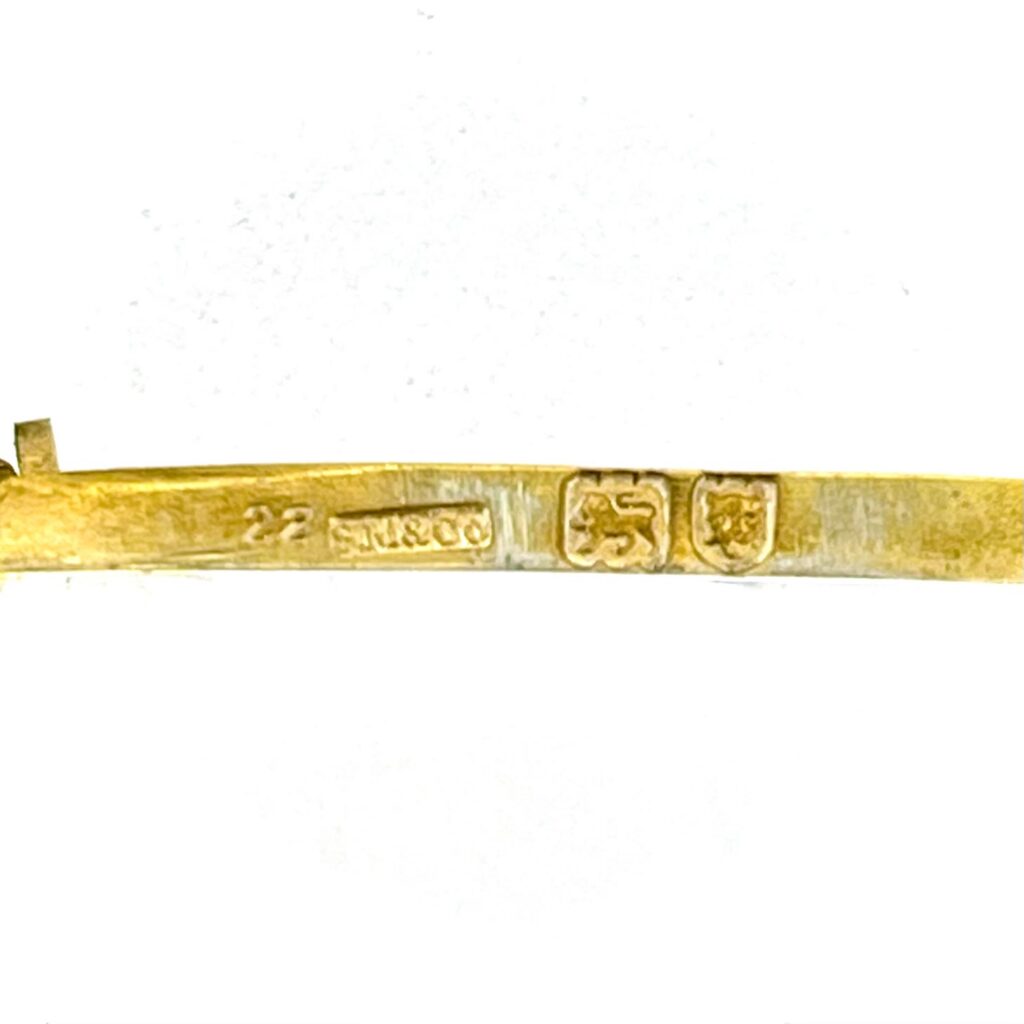
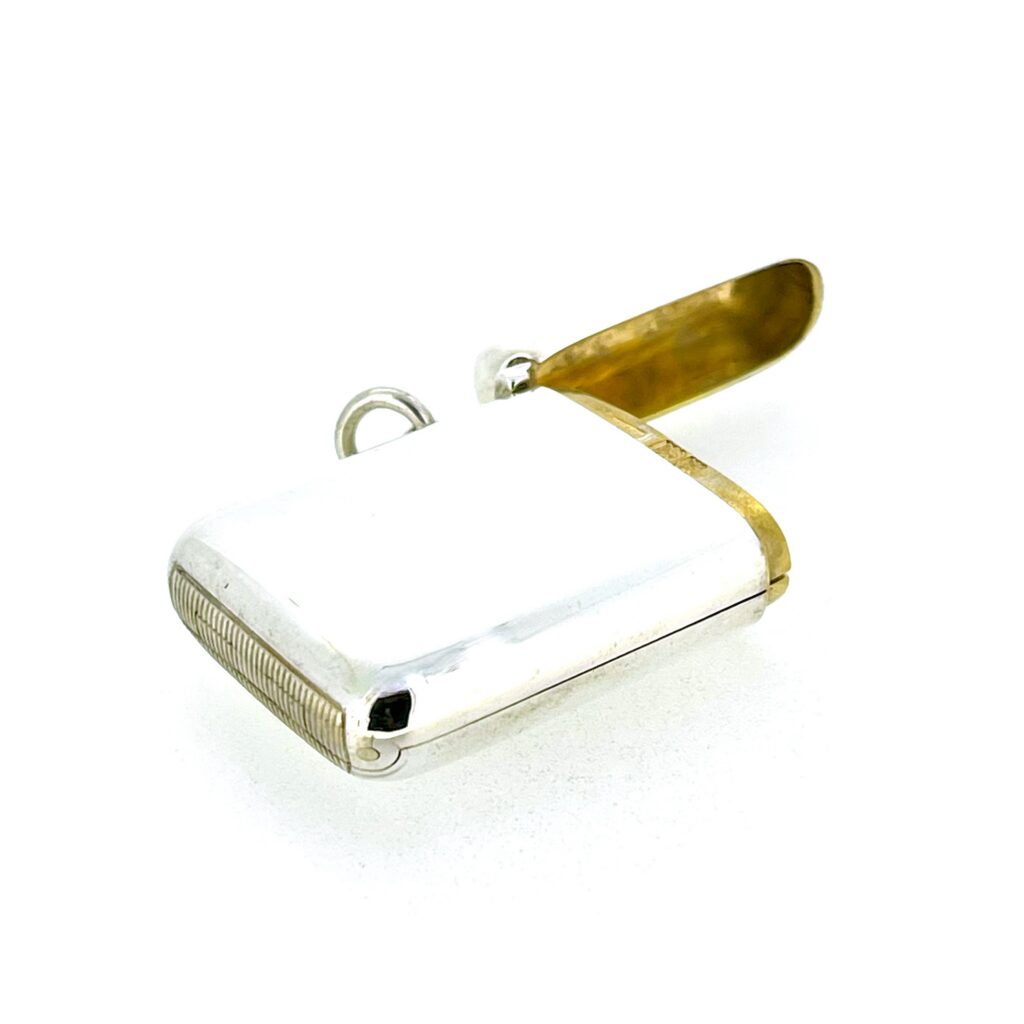
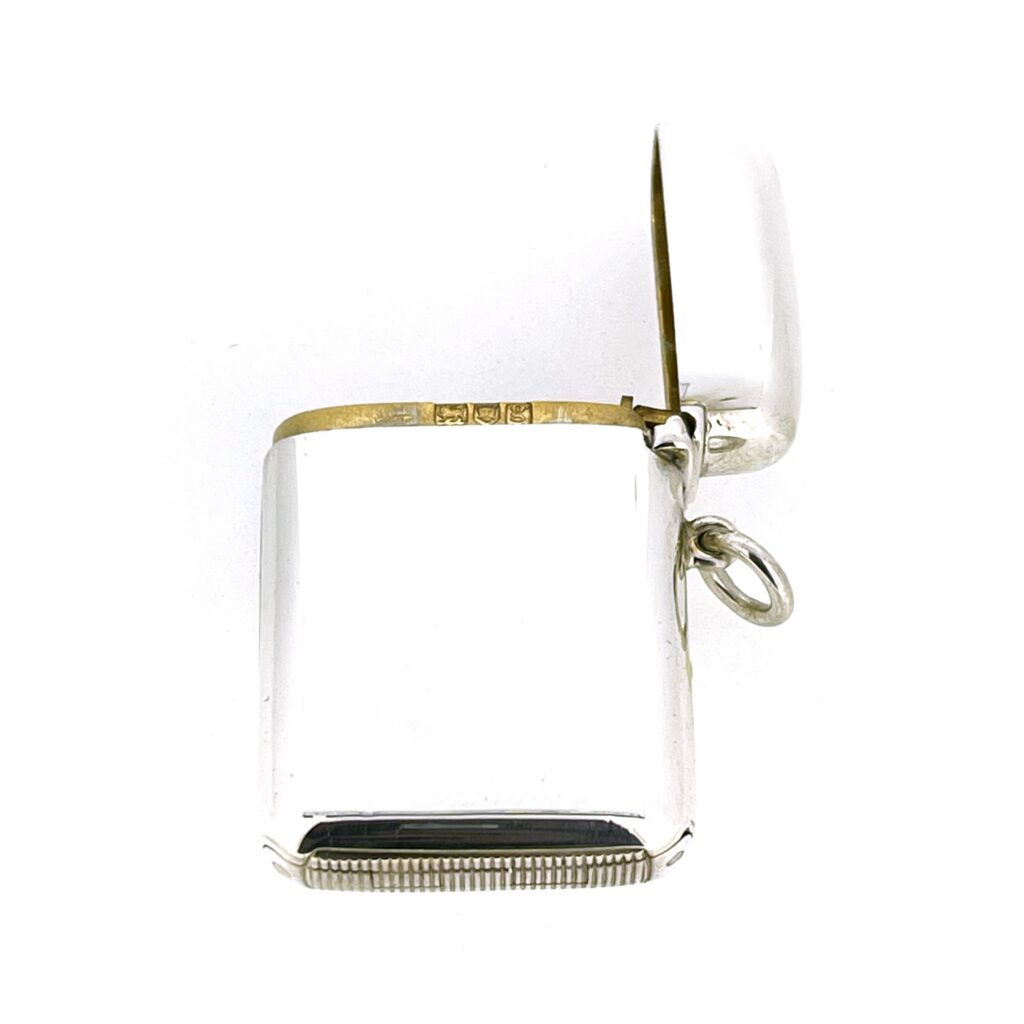
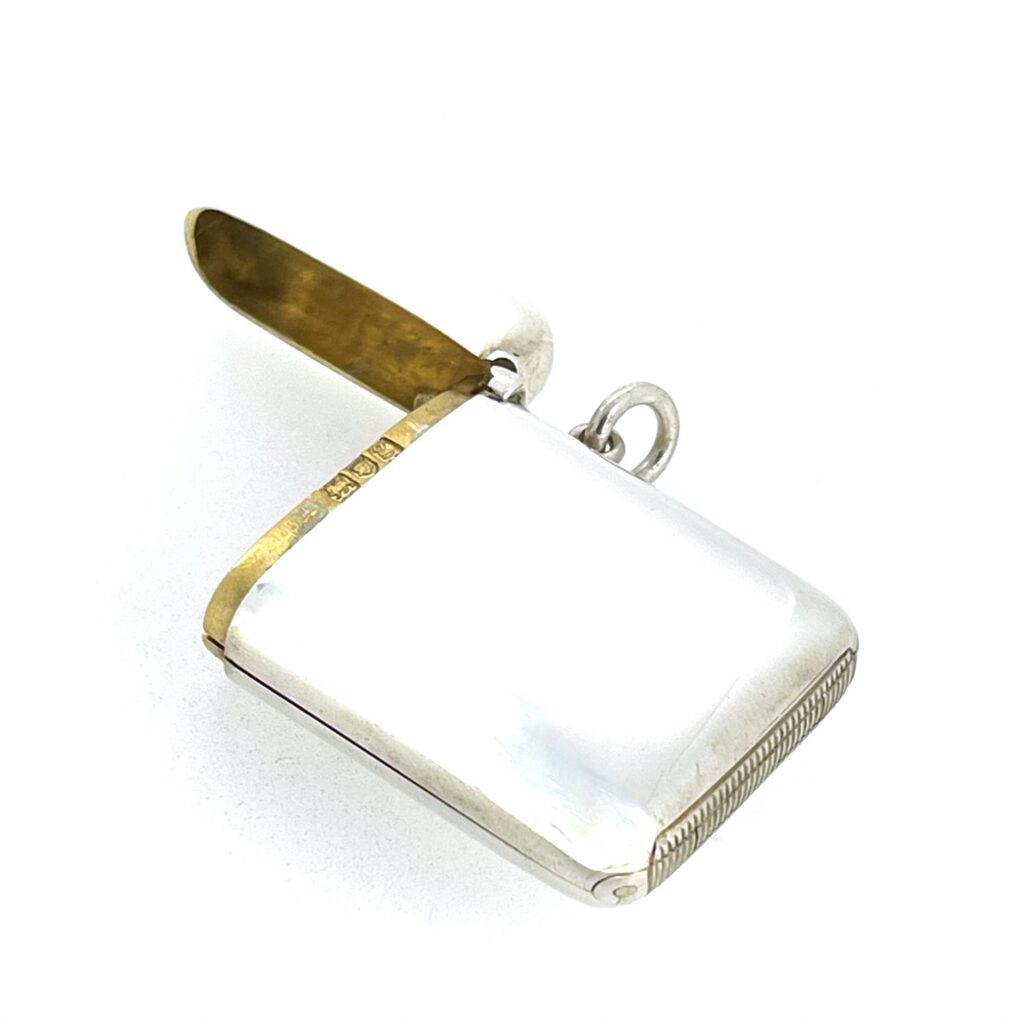
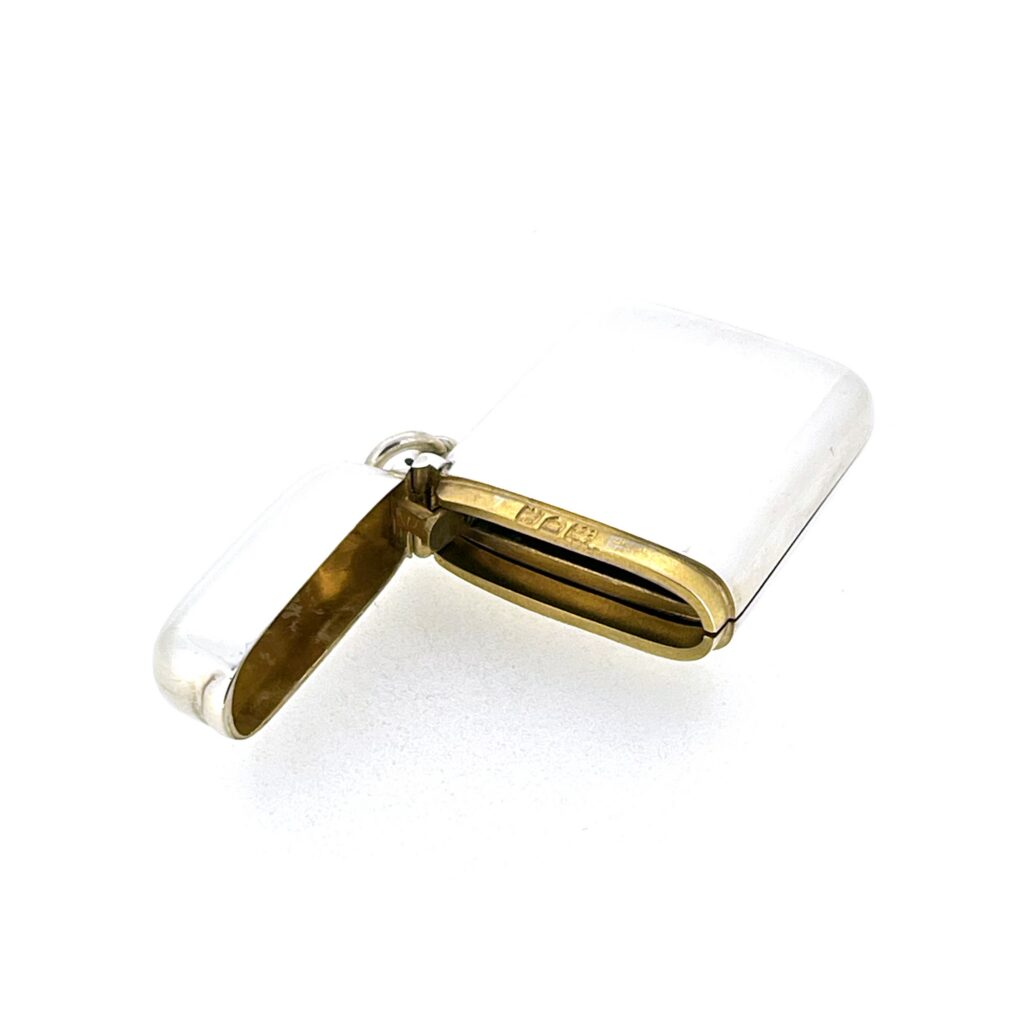
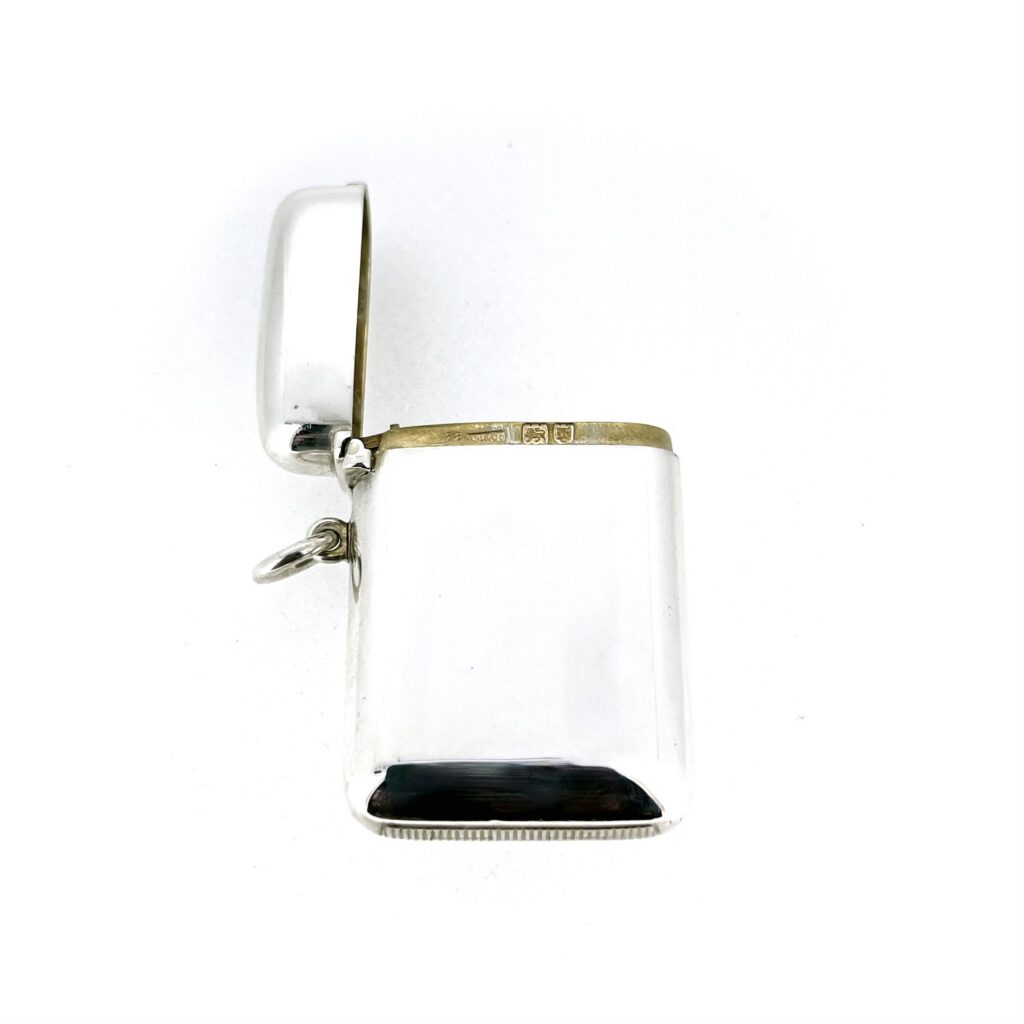
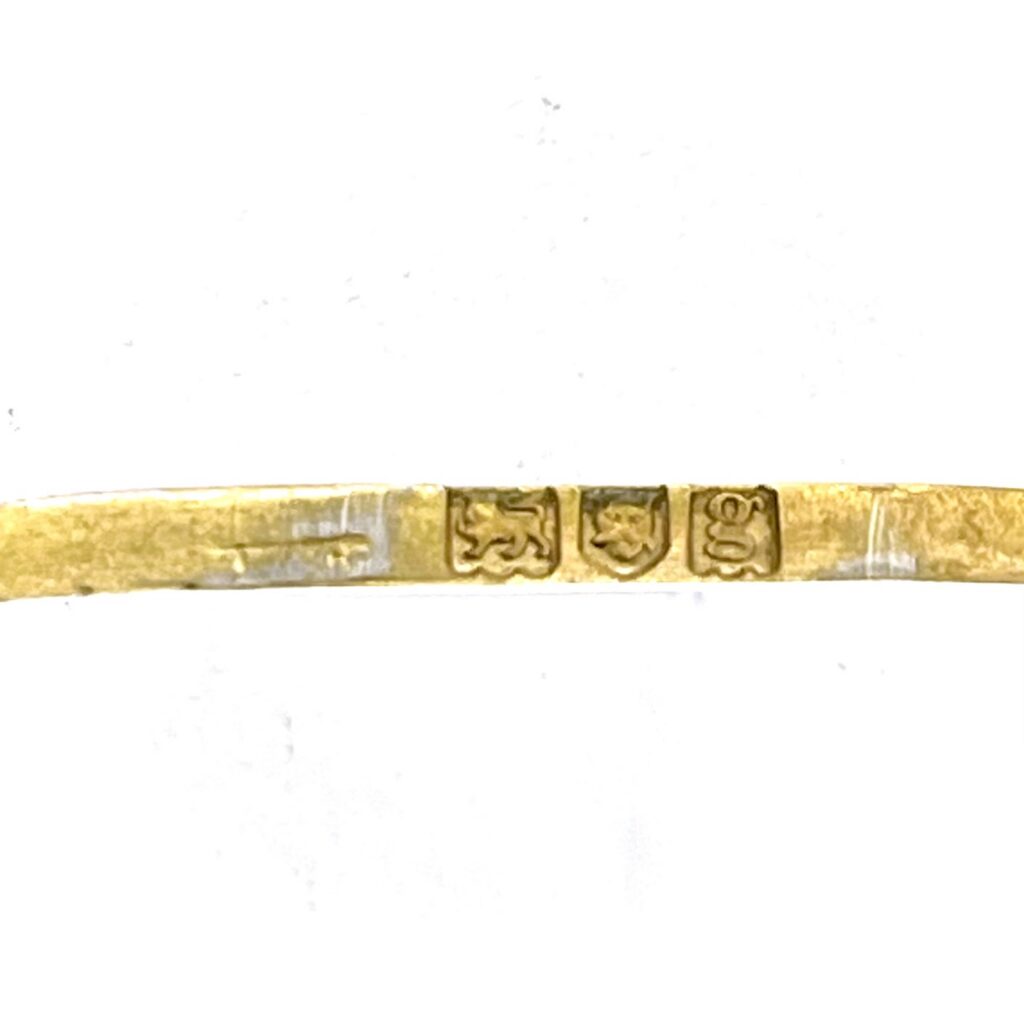
An outwardly restrained Edwardian silver case conceals an intimate second purpose. Made by S. Mordan & Co. and hallmarked in London in 1902, it carried matches within a gilt chamber while a separate hinged panel protected a miniature photograph. In one palm-sized object, public utility and private remembrance were brought together through precise silverwork.
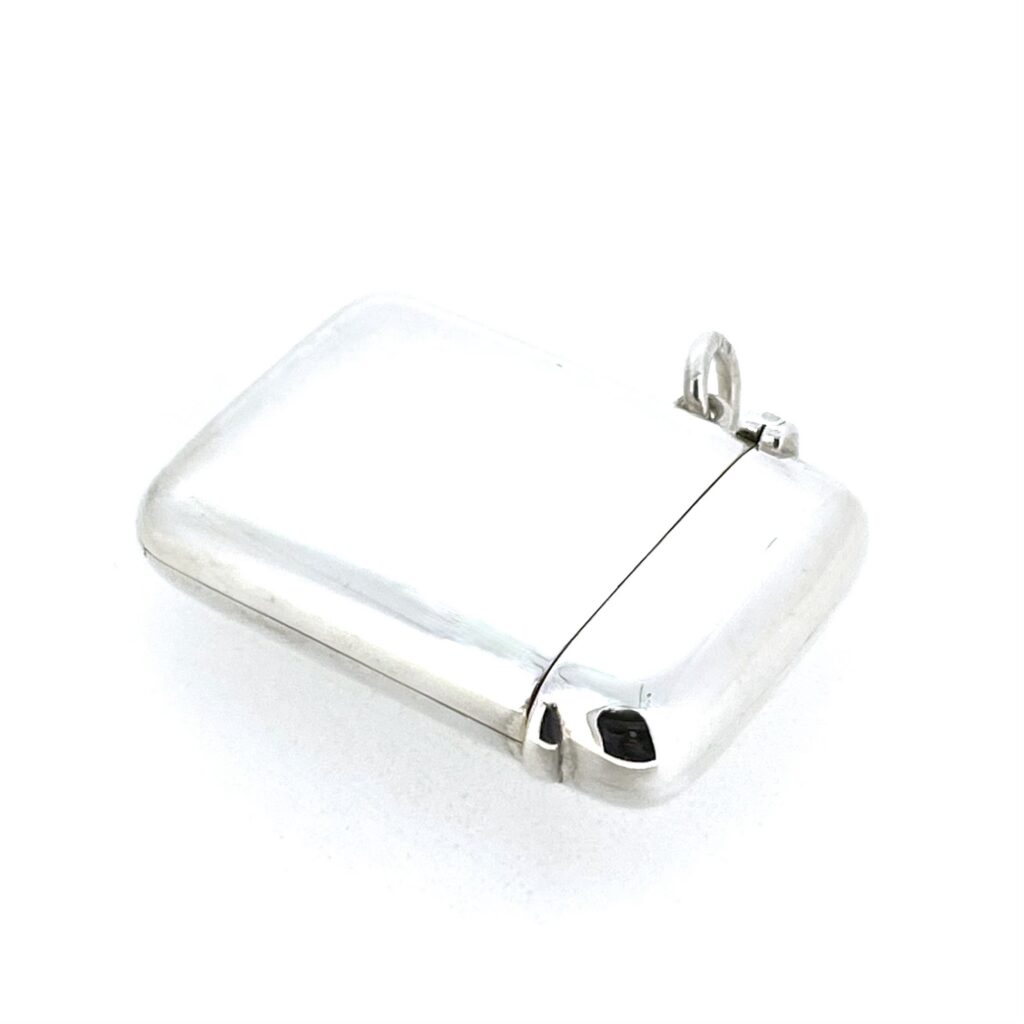
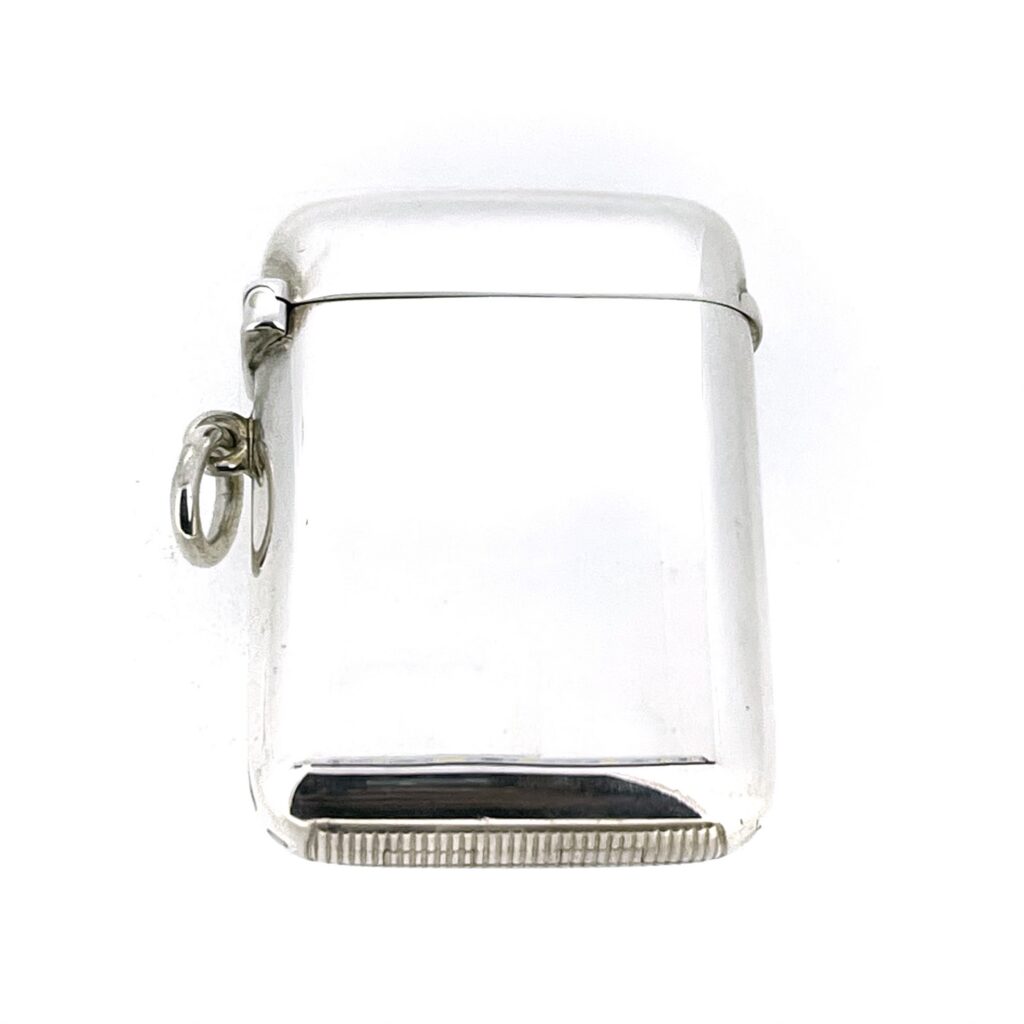
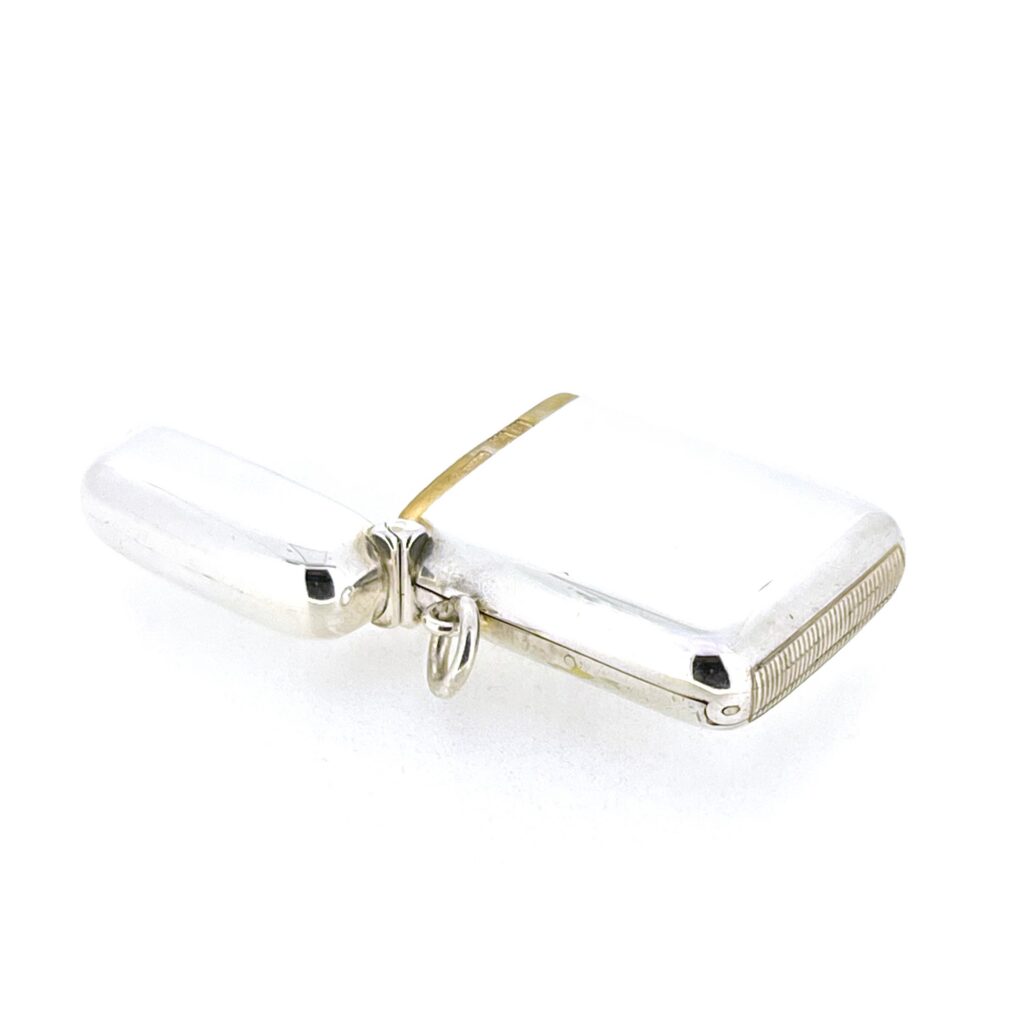
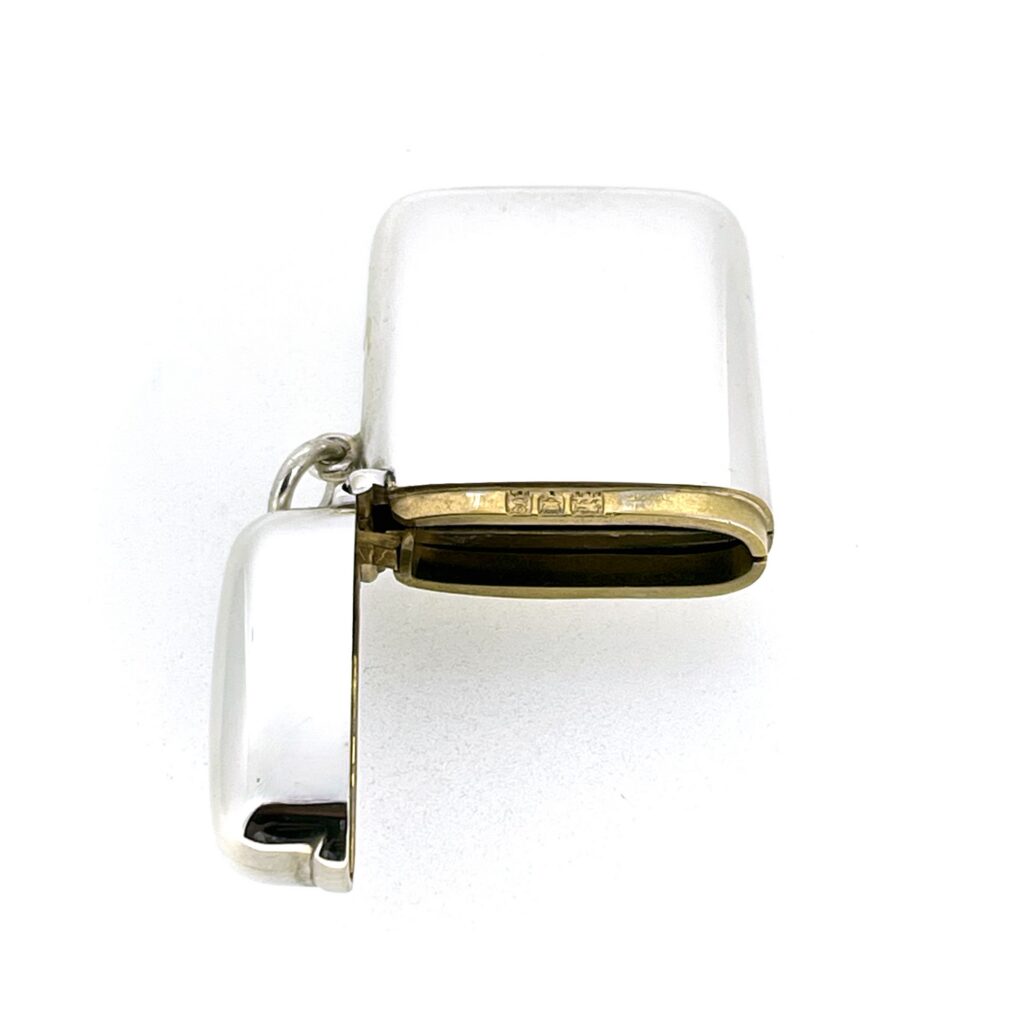
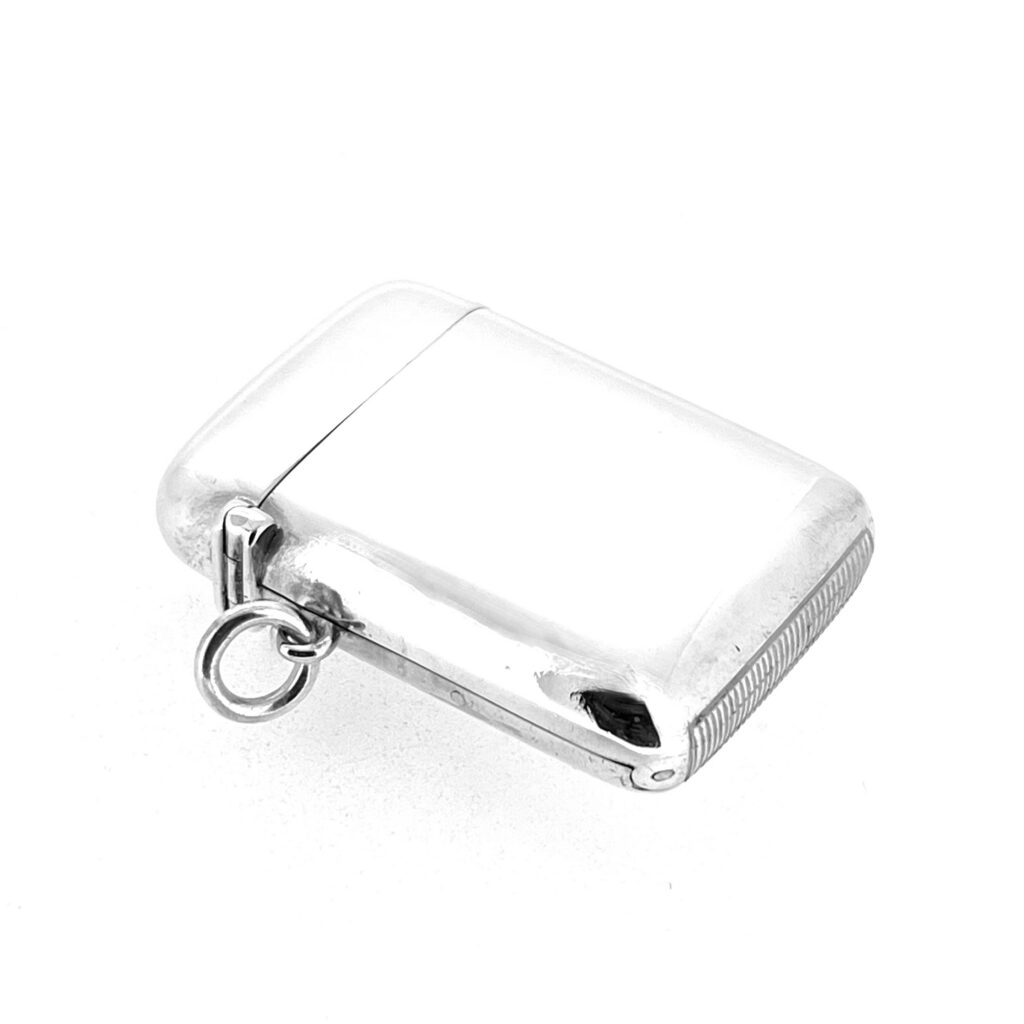
At first sight, the case appears simple. Its polished sterling silver body is compact, rounded and deliberately undecorated. A suspension ring suggests that it could be attached to a pocket chain, fob chain or Albert chain. The sprung lid and striker identify it as a practical object intended to be carried and used.
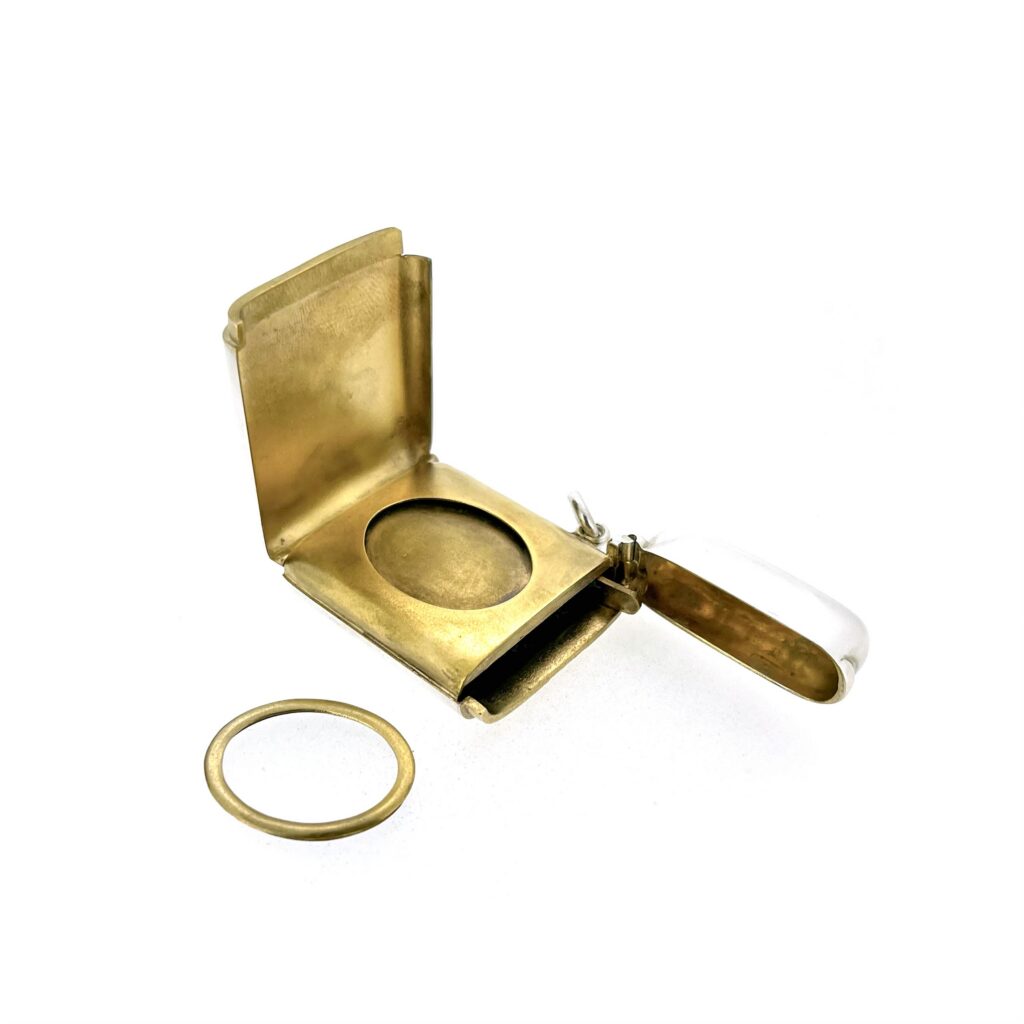
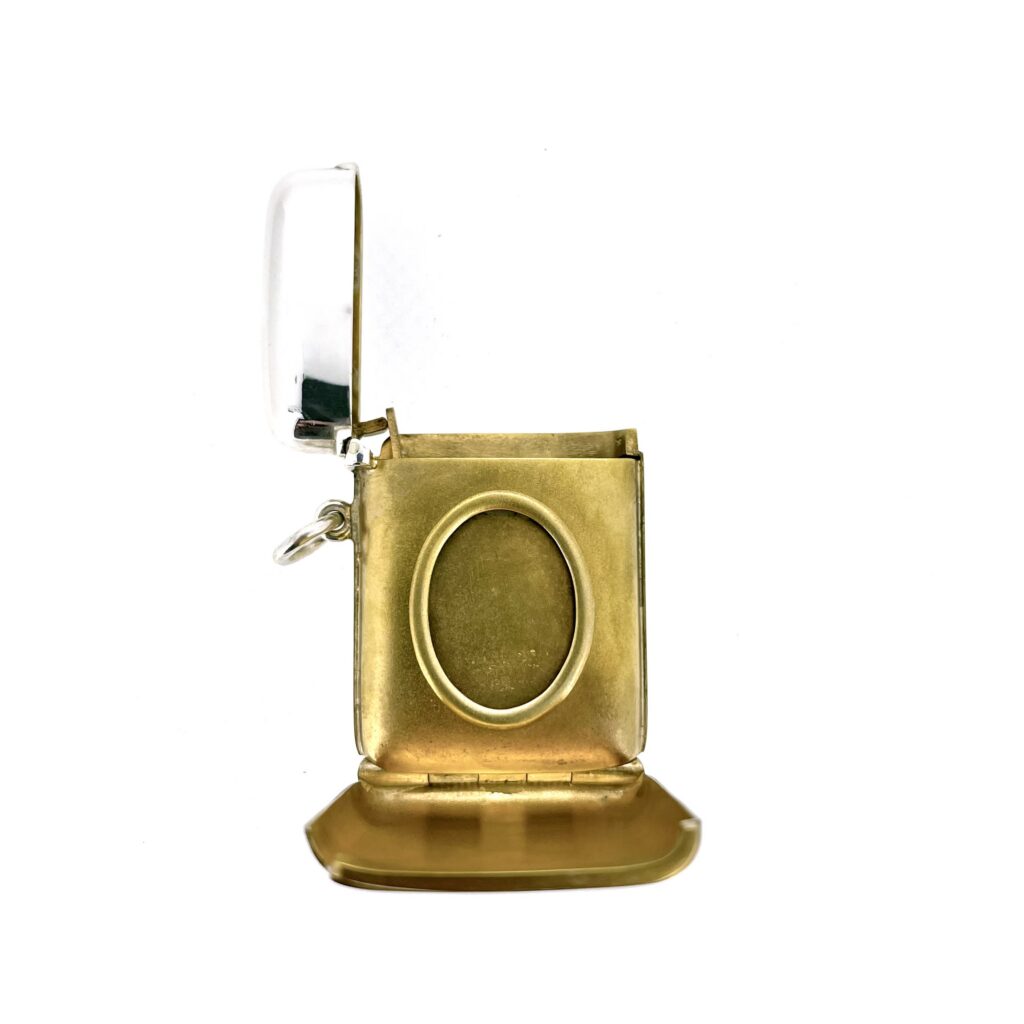
Only when a second panel is opened does the private character of the design become apparent. Beneath the silver exterior is a miniature photograph aperture measuring just 22 × 17 mm. The image was retained behind a removable bezel and remained completely concealed while the case was closed.
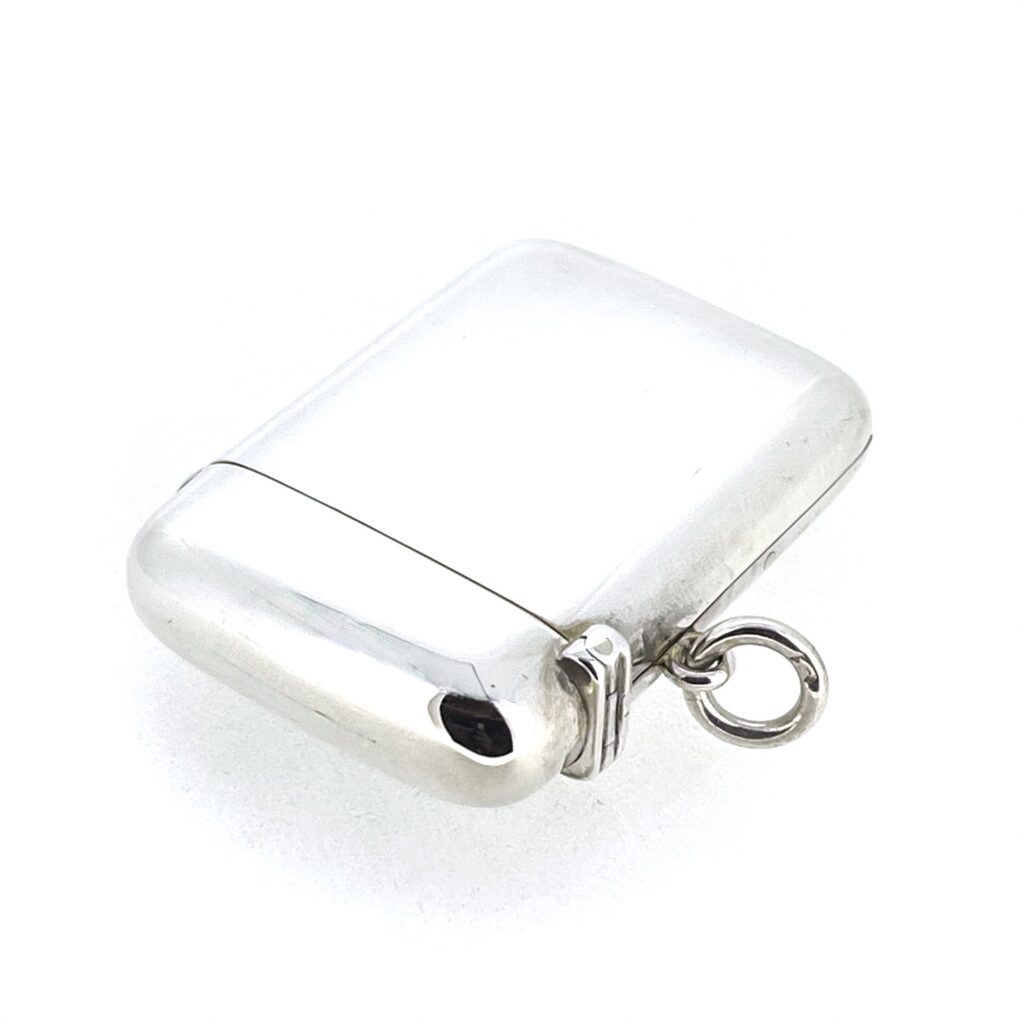
This transformation—from an elegant match case into a personal photograph locket—is the feature that makes the design so compelling. It is also an important example of the way S. Mordan & Co. combined utility, engineering and sentiment within its smallest precious-metal objects.
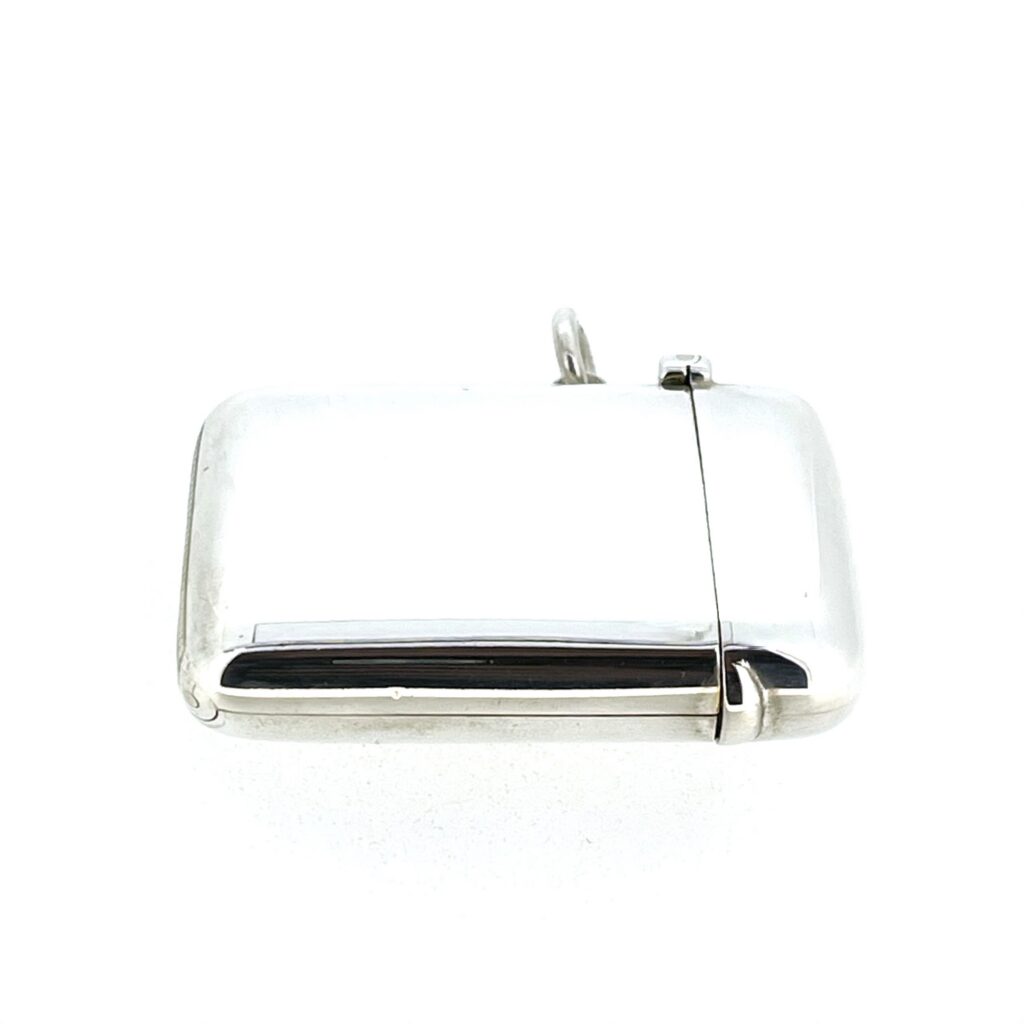
What Is a Sampson Mordan Hidden Photograph Vesta Case?
In brief, it is a combined vesta case and concealed miniature photograph frame. The principal compartment was made to carry loose matches. A second hinged section contained a small portrait, protected from view and from everyday handling by the closed silver panel.
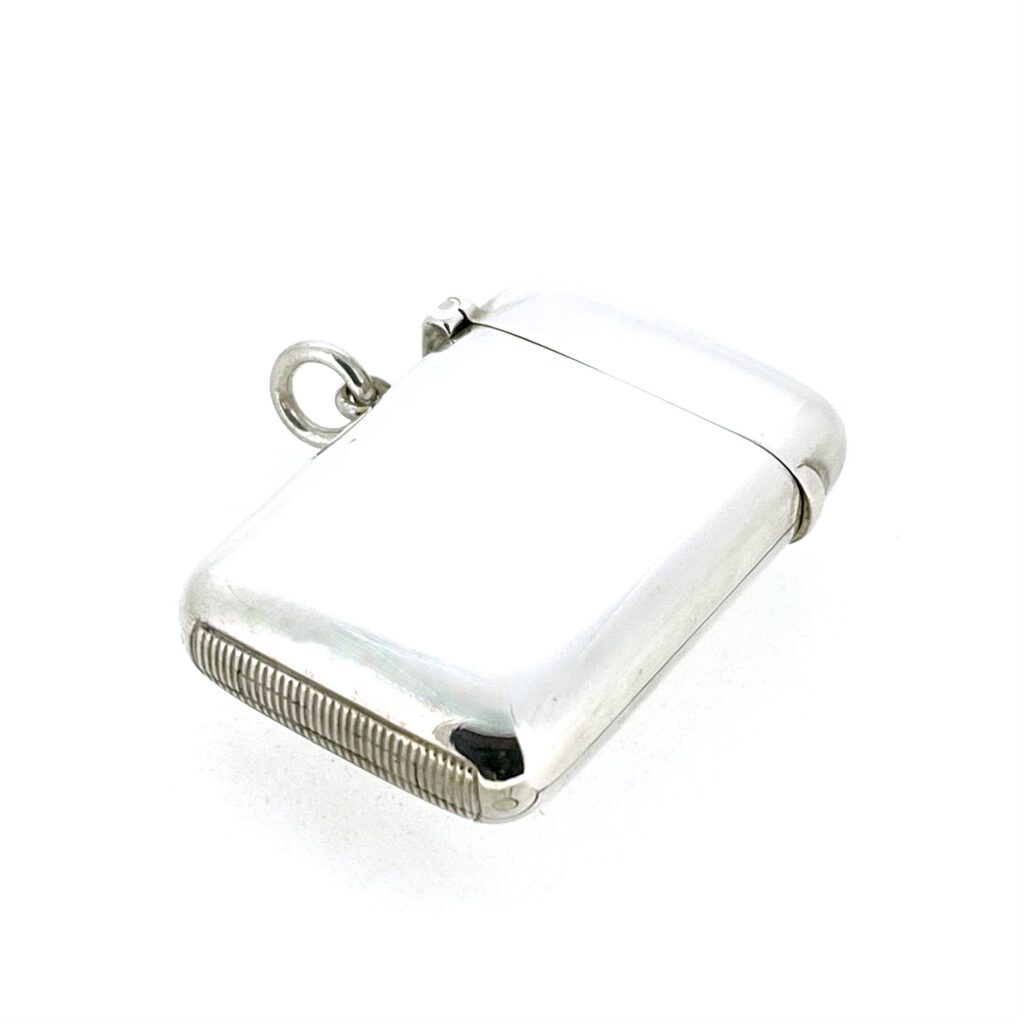
The example documented by the Sampson Mordan Vault was made under the historic S. Mordan & Co. name and hallmarked in London in 1902. It is made from sterling silver, retains a gilt interior and measures approximately:
- Height: 50 mm
- Width: 35 mm
- Thickness: 12 mm
- Weight: approximately 48g
- Photograph aperture: 22 × 17 mm
- Suspension ring: approximately 10 mm

Its precise original catalogue name has not yet been found. “Hidden photograph vesta case” is therefore a useful modern description rather than a confirmed Mordan product title. For museum and archival purposes, the most accurate present description is:
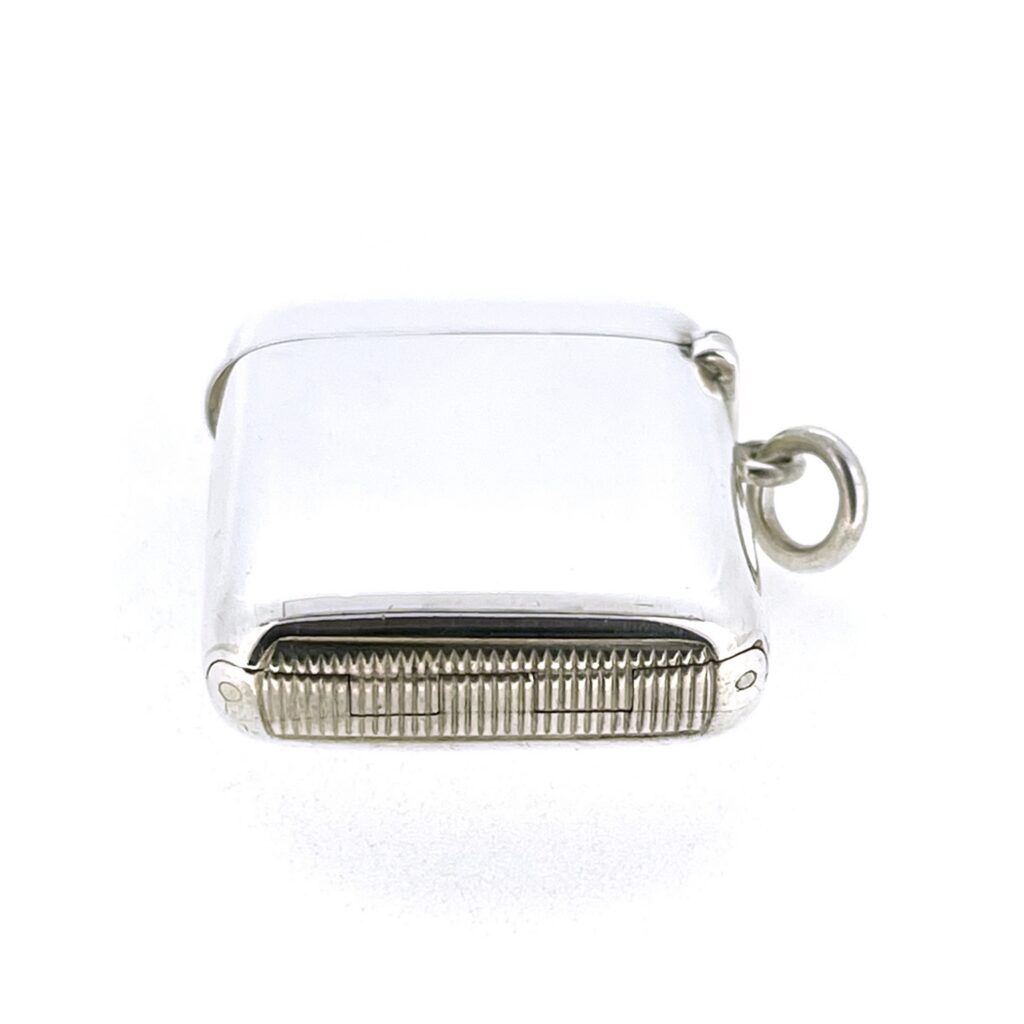
S. Mordan & Co. combined silver vesta case and concealed photograph frame, London 1902.
Why Is It a Vesta Case Rather Than a Matchbox Holder?
The object has previously been described as a hidden photograph matchbox holder. That phrase makes its purpose understandable, but it is probably not the most mechanically accurate name.
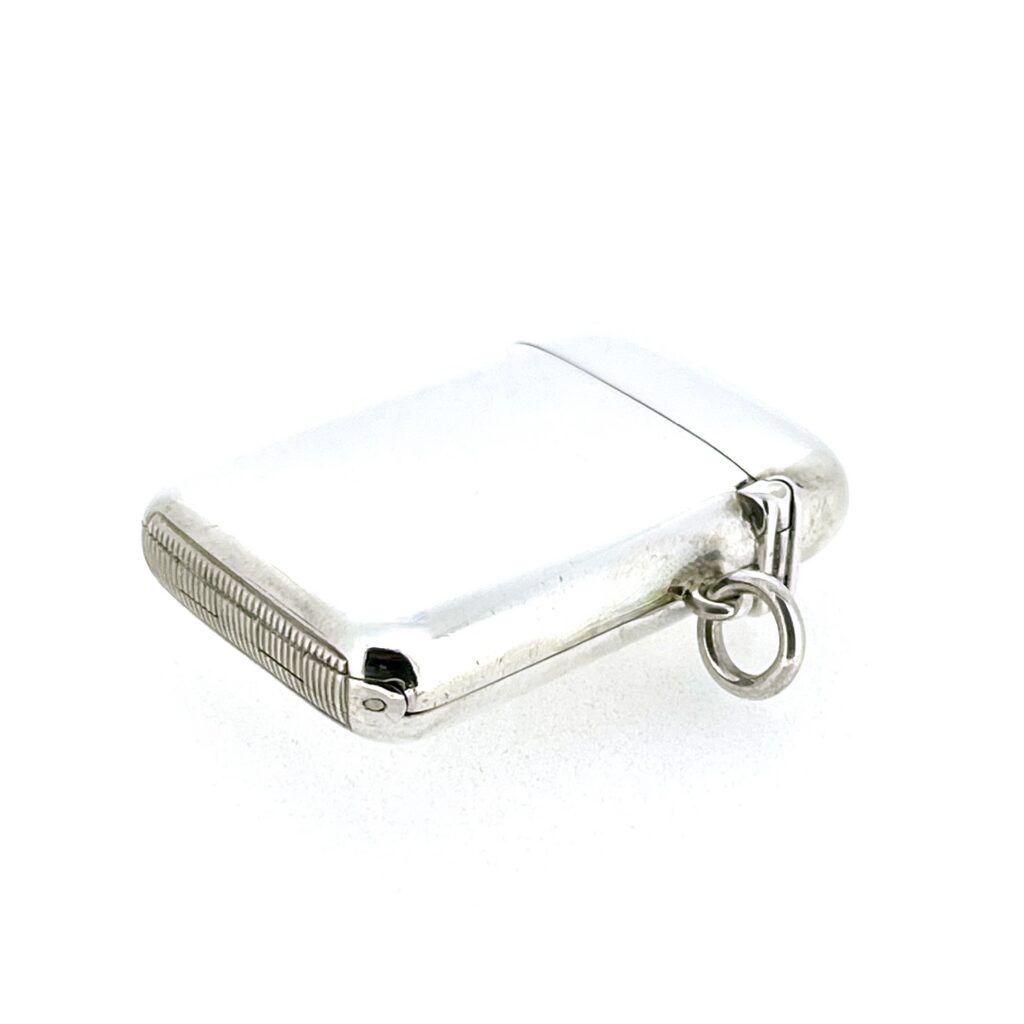
A conventional matchbox holder surrounds or retains a separate cardboard matchbox. A vesta case, by contrast, carries loose matches within its own enclosed chamber and normally incorporates a striking surface. In America, the same broad type is commonly called a match safe.
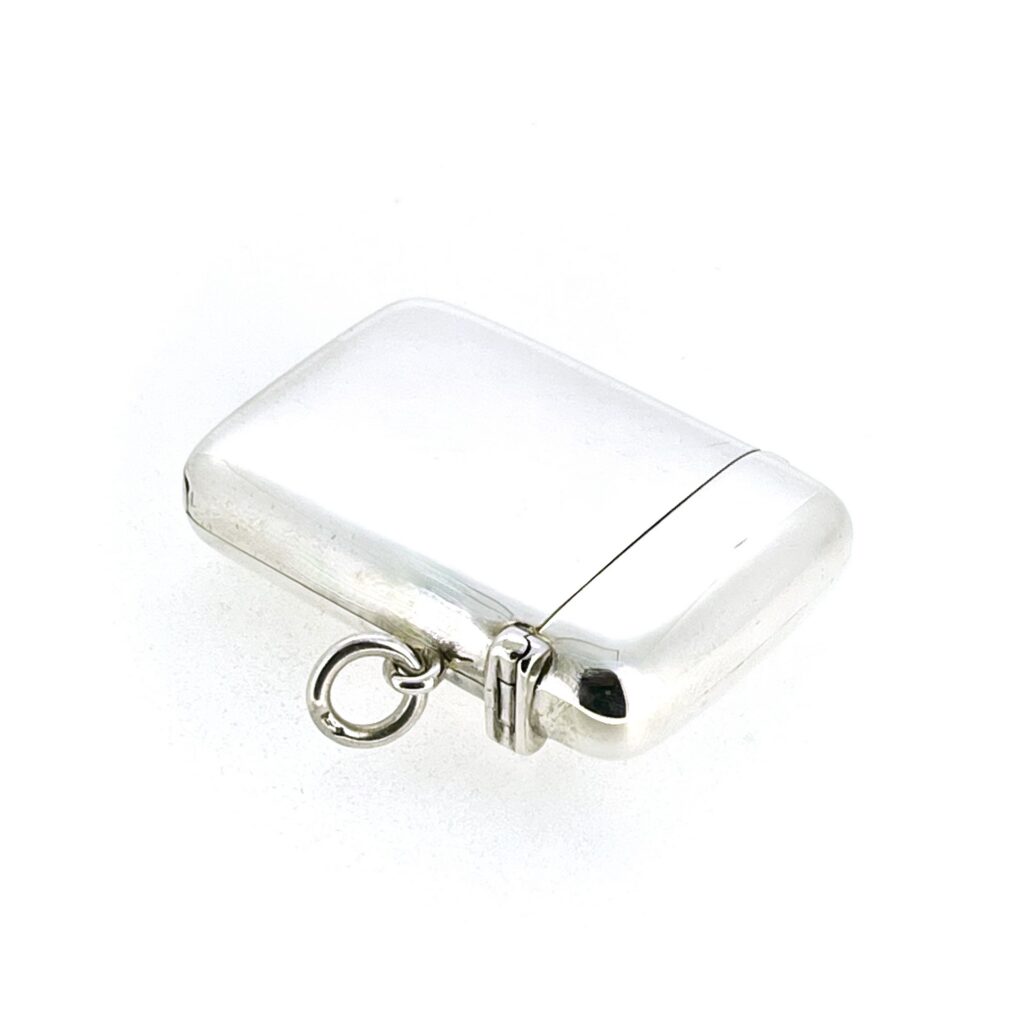
The sprung lid, gilt match chamber and surviving striker wear on the 1902 case all support its identification as a vesta. Closely related surviving objects are also catalogued as vesta cases rather than matchbox covers.
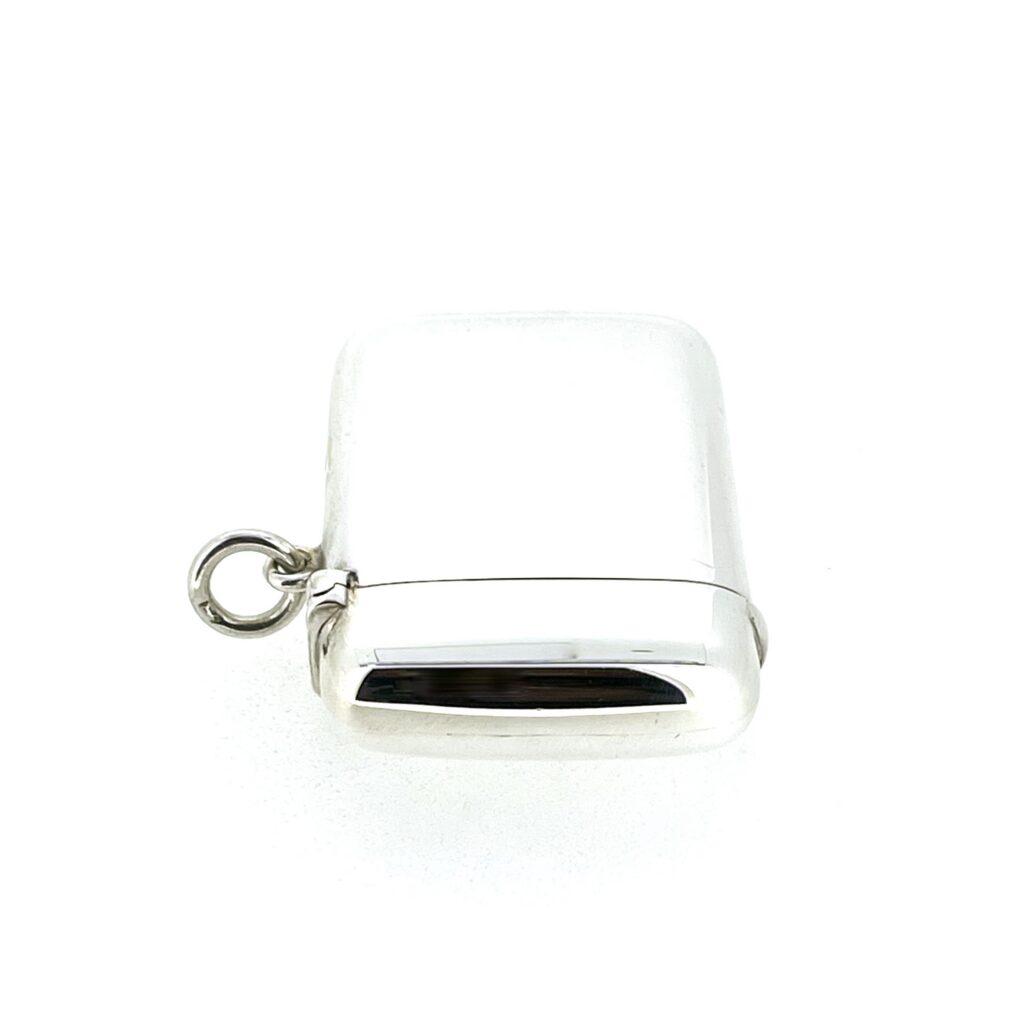
The name derives from the small friction matches once sold as vestas. Matches were vulnerable to moisture and could ignite through accidental friction, so a firm metal container served a practical protective purpose. When made in silver or gold, however, the vesta became far more than packaging. It could be worn or carried as a piece of personal jewellery, engraved as a gift and transformed into an expression of taste.
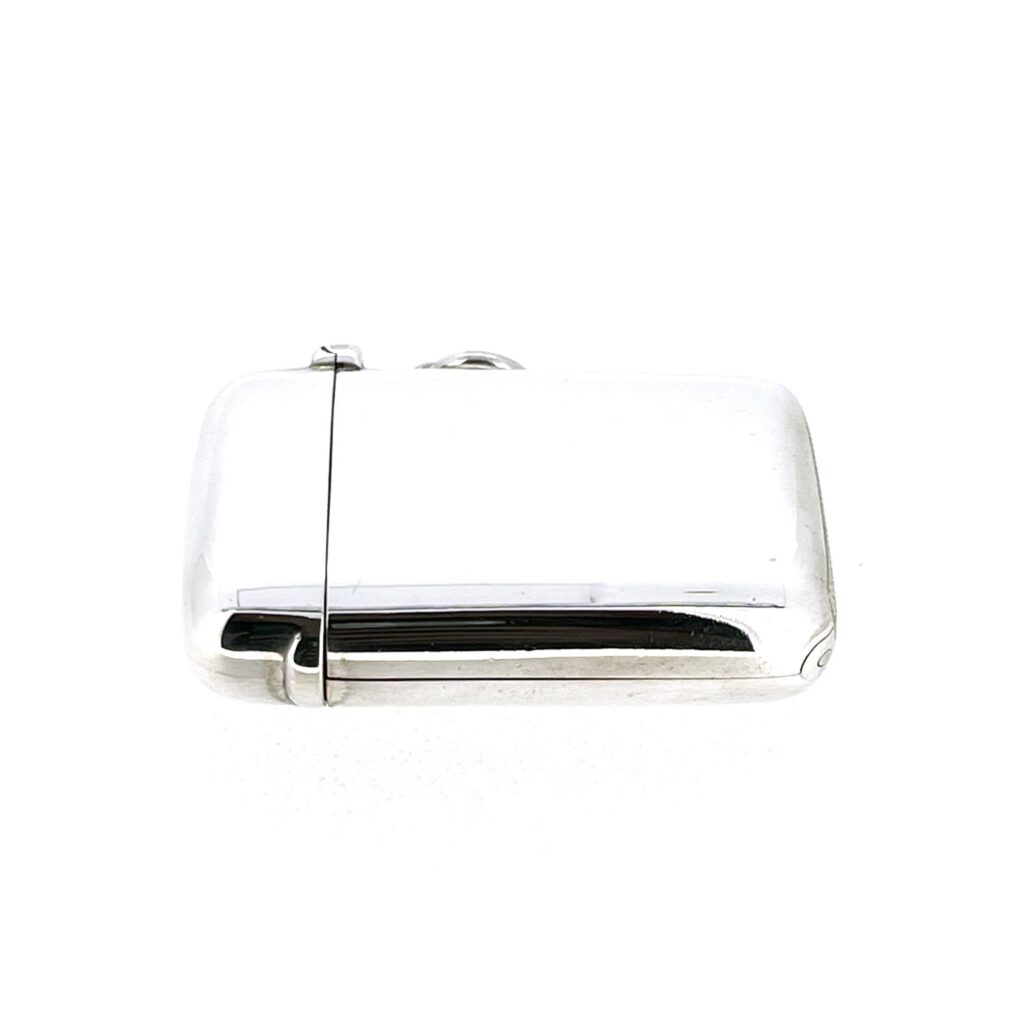
A Mechanical Sequence of Concealment
The design is built around a sequence of discovery.
The closed exterior gives no indication that a photograph is present. The sprung vesta lid opens to reveal the match compartment, allowing the object to perform its public and practical role. A different hinged panel must then be opened deliberately before the portrait can be seen.
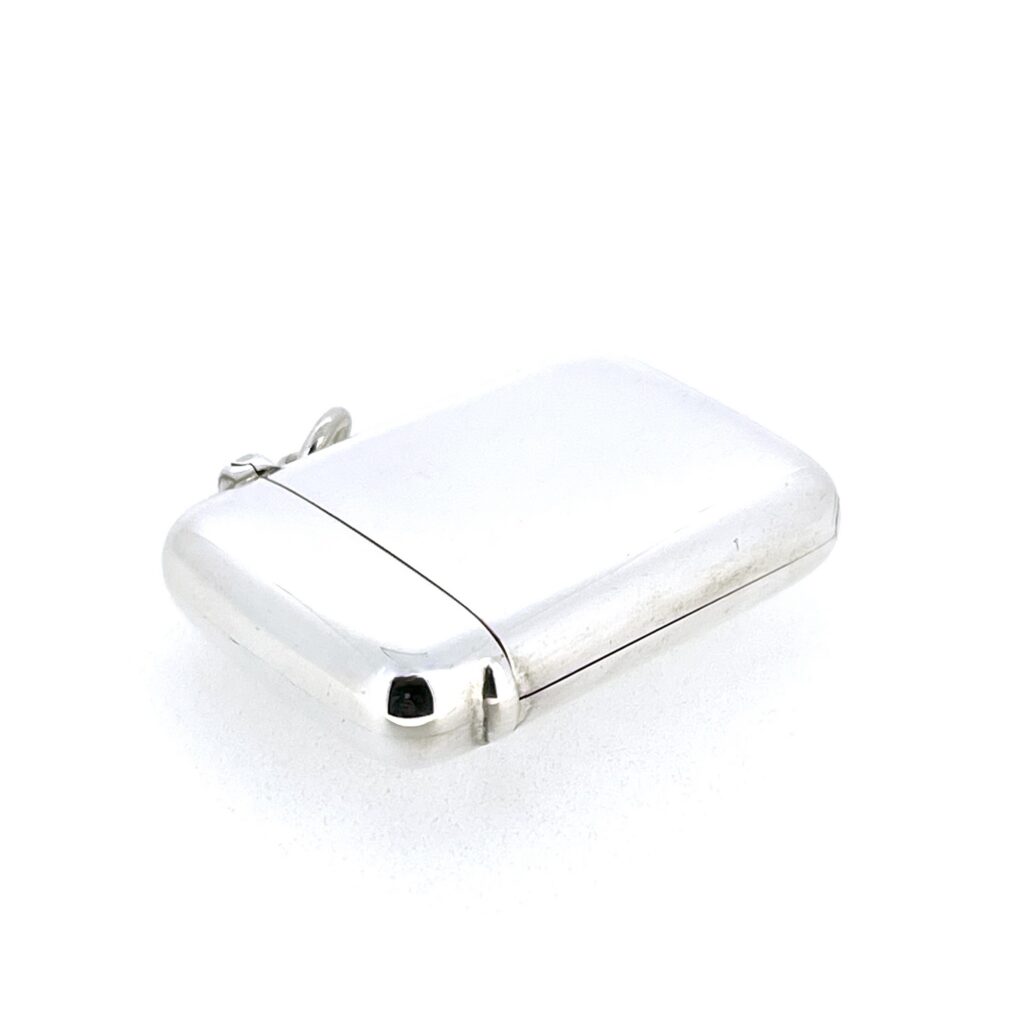
Although the case measures only 50 mm high, it incorporates several separately made components:
- a formed sterling silver body;
- a sprung and hinged vesta lid;
- a secondary hinged portrait panel;
- a removable photograph bezel;
- an integrated striking surface;
- internal divisions and close-fitting edges;
- and a suspension fitting for attachment to a chain.
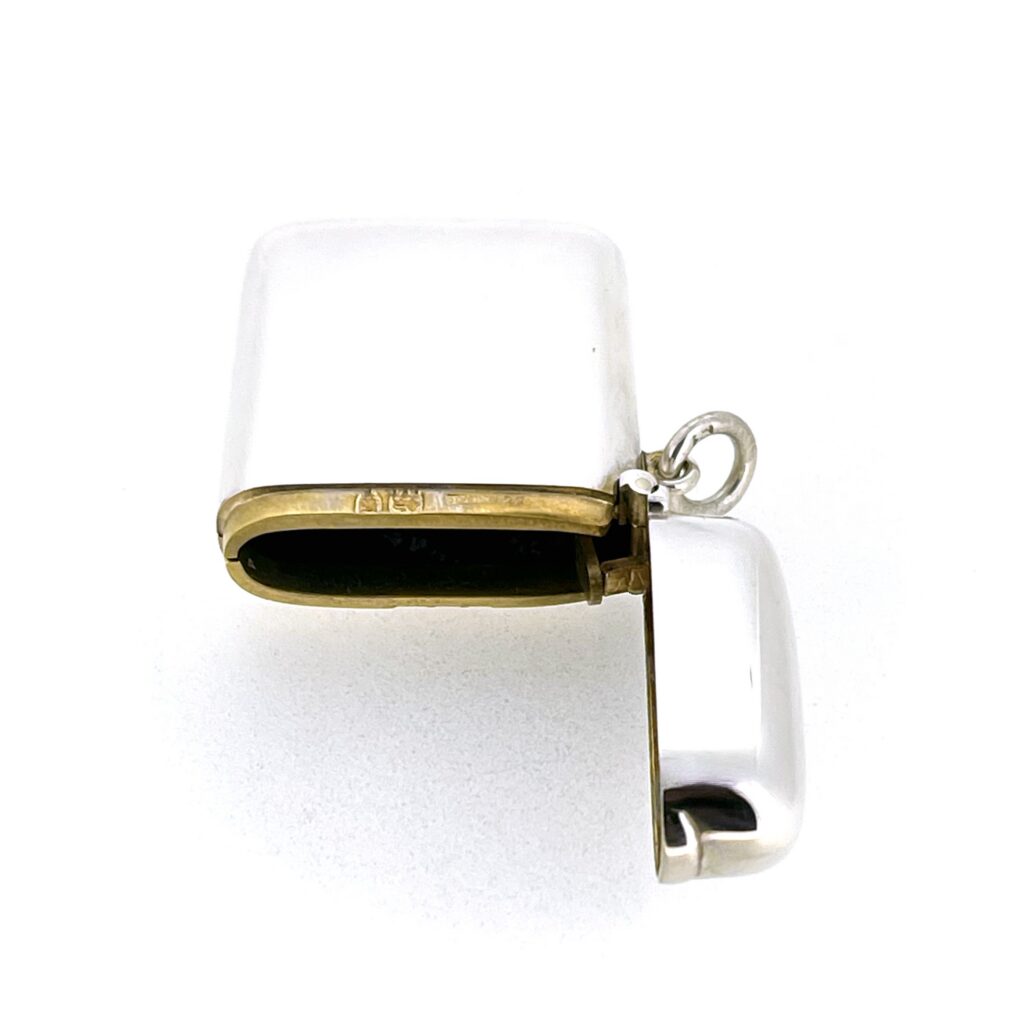
The rounded body and closely fitted moving parts required careful forming, soldering, assembly and finishing. The two functions had to remain distinct while occupying the same shallow case. Matches needed to be accessible without disturbing the photograph, while the portrait required protection from the abrasion and residue associated with regular use.
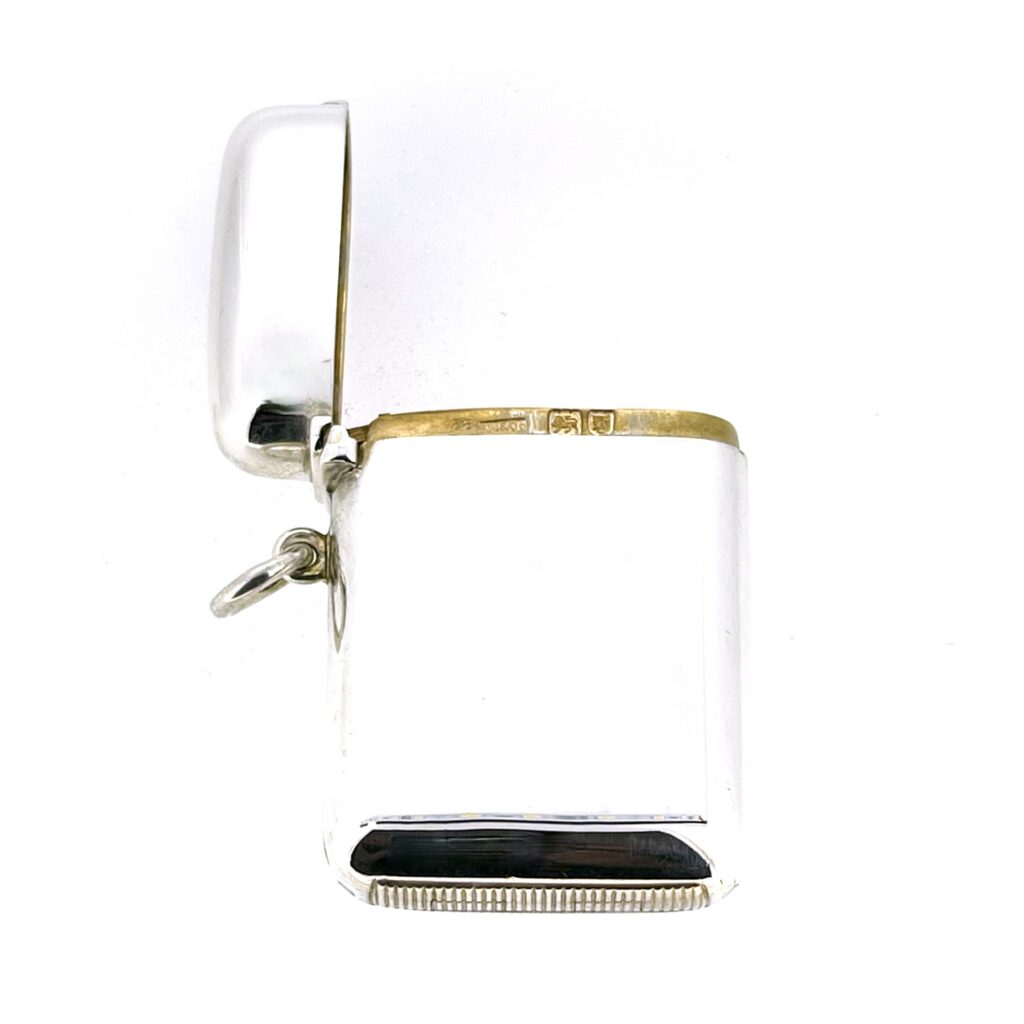
One account of the closely related gold version suggests that opening the outer cover may release a further concealed hinge. Whether the 1902 silver case uses precisely the same interlocking action remains a subject for detailed mechanical examination. Until the hinges, spring and internal release are recorded at close range, it would be premature to describe the mechanism as patented or unique.
A Photograph Small Enough to Carry
The visible portrait opening measures 22 mm high by 17 mm wide. These are the dimensions of the aperture rather than necessarily the dimensions of the photograph itself. The edges of the image would have extended beneath the bezel so that it could be held securely in position.
Several photographic forms could technically have fitted such a compartment. By 1902, small paper portraits could be trimmed from a larger photographic print, while tiny direct-positive images known as gem tintypes were also available. Surviving gem tintypes are often close to three-quarters of an inch by one inch, placing them within the general dimensional range of the Mordan frame.
A carefully cut paper portrait is presently the leading interpretation. Albumen photographs were capable of producing the warm brown or sepia appearance associated with many Victorian portraits, while gelatin silver paper was becoming increasingly important around the beginning of the twentieth century.
A tintype remains possible, but the visible opening alone cannot identify the photographic process. The complete recess, support thickness and bezel construction would need to be examined. An ambrotype on glass would have been more fragile and less convenient for such a shallow moving object, although it cannot be excluded solely from the aperture measurement.
The original protective arrangement is also unresolved. The portrait may have been covered by thin glass, mica or another transparent material, but no documentary specification for the Mordan design has yet been found. The possibility that the bezel retained the photograph without separate glazing must also remain open.
The Gold Example and the Portrait of a Child
The most revealing comparison is a closely related S. Mordan & Co. case made in 9ct gold and hallmarked in London in 1900.
That example shares the compact form and stated dimensions of approximately 50 × 35 × 12 mm. Its photograph compartment retains a sepia portrait of a baby, while an inscription records:
Walter from Nell
Dec. 7. 01
The gold case appeared in a specialist dealer archive and later returned to the market at auction in 2024. Its matching hallmarks, measurements, weight, inscription and surviving portrait show that these records describe the same individual object rather than two separate examples.
The portrait is valuable evidence because it demonstrates how the hidden compartment was actually used. It contained a personal family image, not merely an ornamental insert or an imagined clandestine portrait.
We cannot identify Walter, Nell or the child from the inscription alone. Nor can we establish the precise occasion on which the case was given. It may have marked a birthday, anniversary, Christmas or another private event. What can be said is that the object was presented as an intimate gift and that the concealed photograph formed a meaningful part of it.

This surviving gold example cautions against the more sensational descriptions sometimes applied to hidden-photograph cases. Later collectors have occasionally called them “mistress cases”, but concealment does not prove an illicit relationship. The image could equally have represented a spouse, child, parent or another person whose likeness the owner wished to carry privately.

Why Combine Matches and a Portrait?
At the beginning of the twentieth century, personal photography and portable fire had both become part of everyday life. Their combination within one precious-metal object may initially appear unusual, but the design answered practical, emotional and social desires simultaneously.
A frequently handled possession
A vesta was not normally left untouched in a cabinet. It was carried, held, opened and used. Attaching a portrait to such an object connected the image with a repeated personal ritual. The photograph travelled with its owner and could be viewed whenever the case was taken from a pocket.
Privacy without outward decoration
The plain exterior offered discretion. Nothing on the closed case revealed that it contained an image or indicated whose portrait might be hidden within. The practical vesta could be used openly in company while the portrait remained visible only when the owner chose to reveal it.
Protection for a fragile image
A tiny photograph carried loose in a pocket would quickly become creased, scratched or stained. The silver panel and retaining bezel protected it from light, friction and handling. By incorporating the image into the body of the case, Mordan gave a fragile likeness a durable precious-metal setting.
Two objects occupying one pocket
Combination objects were part of Mordan’s wider design language. A single compact form could accommodate several purposes without appearing cumbersome. The hidden-photograph vesta saved space, but its appeal was not merely efficient. Its charm lay in the contrast between the two functions: the social act of producing a match and the private act of looking at a portrait.
Matches, Smoking and the Edwardian Pocket
Vesta cases are closely associated with the culture of smoking, although matches were also needed for candles, fires and other domestic uses. For a gentleman wearing a waistcoat, a silver or gold vesta could be carried on an Albert chain alongside a watch, sovereign case, seal or other personal accessory.
The 10 mm suspension ring on the 1902 case is compatible with an Albert chain, fob chain or pocket chain. Its exact original mode of wear has not been documented, and the fitting should not be interpreted as proof that it was always intended for one particular form of chain.
Nor does the design prove that every purchaser was male. Its proportions and relationship to waistcoat accessories make the gentleman’s pocket a persuasive commercial context, but small photograph cases and precious-metal gifts also circulated among women. The surviving mechanism tells us how the case functioned; it does not, by itself, identify its first owner.
Where the Design Fits Within the Work of S. Mordan & Co.
Sampson Mordan became celebrated for the transformation of compact practical objects into finely engineered personal possessions. The firm’s pencils are the most familiar example, but its output extended far beyond writing instruments.
Vesta cases, sovereign cases, stamp cases, card cases, scent bottles, dressing accessories, lockets and ingenious combination objects all relied upon related skills: accurate fabrication, miniature hinges, springs, close-fitting lids, precious-metal finishing and an understanding of how objects behaved in the hand or pocket.
The hidden-photograph vesta sits at the meeting point of four particular Mordan strengths:
- case making, through the compact and durable silver body;
- small mechanical work, through the sprung lid and secondary hinge;
- jewellery-scale framing, through the miniature portrait bezel;
- combination design, through the union of two distinct functions.

Its plainness is an important part of the design. Other Mordan vestas survive with enamel, figural forms, inscriptions and visual jokes. This example creates interest through restraint. Its most meaningful detail is not engraved or displayed on the surface. It is withheld until the object is opened.
Three Mordan Examples Presently Identified
Research undertaken for the Sampson Mordan Vault has so far identified three individual S. Mordan & Co. examples of this closely related hidden-photograph vesta design.
London 1899 — silver
The earliest presently identified Mordan example is a silver case hallmarked in London in 1899. It was described as a plain rounded oblong vesta with a gilt interior, a hinged front panel and a small oval portrait frame. Its recorded height was 54 mm and its weight approximately 46.7g.
The difference between its stated height and the later 50 mm examples could indicate a slightly larger version. It could also result from the suspension ring being included in one measurement but excluded from another. Detailed photographs and consistent measurement methods are required before the existence of two sizes can be claimed.
London 1900 — 9ct gold
The gold example bears London hallmarks for 1900 and retains the baby portrait and Walter-and-Nell inscription. It measures approximately 50 × 35 × 12 mm and weighs about 35.8g. Its survival demonstrates that the design was offered in more than one precious-metal tier.
London 1902 — sterling silver
The silver example documented by the Sampson Mordan Vault is hallmarked in London in 1902. It measures 50 × 35 × 12 mm and weighs approximately 48g. Its photograph opening measures 22 × 17 mm and is surrounded by a removable bezel.
The shared dimensions of the 1900 gold and 1902 silver cases strongly suggest that Mordan used a stable body pattern across the two metals, although detailed side-by-side examination would be needed to establish whether every mechanical component is identical.
These records establish that the Mordan design was being made by 1899 and remained in production in 1902. They do not prove that 1899 was the first year or 1902 the last.
How Rare Is the Design?
The design is rare within the presently documented Mordan corpus. Three individual examples have been identified in records examined for the first stage of our research: two in silver and one in 9ct gold.
That does not mean that only three were made or that only three survive. Further examples may remain in private collections, uncatalogued museum holdings or sale archives recorded under different descriptions. A case described simply as a silver vesta, photograph locket, match safe or pocket case could easily escape a narrow search.
The responsible conclusion is therefore that this is one of three presently identified Mordan examples, not that it is one of only three surviving examples.
This distinction matters. Rarity should emerge from evidence rather than from the certainty of sales language. The current census is a beginning that can be expanded as more objects, photographs and archival records emerge.
Was the Hidden-Photograph Vesta Unique to Mordan?
No. The idea was uncommon, but the present evidence shows that several British and American makers explored closely related combinations around the end of the nineteenth century.
British examples presently identified include:
- W. Neale, Sheffield, 1898;
- George Brace, London, 1898;
- S. Blanckensee & Sons, Birmingham, 1899;
- Bernstein Brothers, Birmingham, 1900;
- Joseph Gloster, Birmingham, 1901 and 1905;
- and Thomas Biston, Birmingham, 1908.
American silver match safes with concealed portrait frames are also recorded from the late nineteenth century. The concept was therefore part of a small international fashion rather than a form that can presently be attributed exclusively to Mordan.
The wider chronology is revealing. The earliest British examples located so far date from 1898, immediately before the first presently identified Mordan case. Comparable Birmingham production continued until at least 1908. This places the hidden-photograph vesta within a relatively concentrated period of design experimentation spanning the final years of Queen Victoria’s reign and the Edwardian era.
Mordan’s distinction lies not in a proven claim to invention, but in the controlled refinement of the idea. The documented Mordan cases have restrained exteriors, precious-metal construction and a particularly coherent relationship between the practical chamber and the concealed portrait.
Was the Mechanism Patented or Registered?
No patent number or registered-design number for this exact Mordan mechanism has yet been located. No such number is presently recorded on the 1902 case.
This must not be interpreted as proof that no protection existed. A registration number might have appeared in a catalogue rather than on the object, been associated with an internal component, or been filed under the name of a designer, wholesaler or mechanism supplier.
A patent would normally have protected a new functional mechanism, such as a release, spring or interlocking hinge. A registered design would have protected the appearance or configuration of the object. These are different forms of evidence and must be searched separately.
The surviving registered-design records for the period are principally held at The National Archives. The most useful next step is a proprietor-name search in the relevant registers under S. Mordan & Co., Sampson Mordan and associated company-name variants, followed by examination of any surviving design representation.
Because several makers produced related hidden-photograph vestas within a short period, several explanations remain possible. The mechanism may have been freely imitated, supplied by a specialist workshop, licensed between manufacturers or independently developed in slightly different forms.
Until an official drawing, patent specification or period catalogue description is found, Mordan should not be described as the inventor of the hidden-photograph vesta.
What Did Contemporary Buyers Call It?
The exact Mordan product name remains unknown.
Modern records use descriptions including hidden photograph vesta, vesta with photo compartment, combined vesta and photo frame, photograph locket vesta and match safe with concealed photograph frame. These phrases describe the surviving objects but do not establish what appeared in a Mordan catalogue.
A facsimile of an 1898 Sampson Mordan catalogue is known to survive and is a priority for continuing research. If the design appears within it, the catalogue may establish:
- the original retail name;
- a model or stock number;
- whether silver and gold versions were offered together;
- the intended image format;
- the original retail price;
- and whether engraving or chain fittings were optional.
Until that evidence is examined, “hidden photograph vesta case” remains the clearest public description, while “combined vesta case and concealed photograph frame” is the preferred technical designation.
Museum and Collection Context
No exact Mordan hidden-photograph vesta has yet been located in the publicly searchable online catalogues of the major museum collections examined during this first research stage.
This is not evidence of museum absence. Small silver objects may be incompletely digitised, catalogued under unexpected terminology or held within study collections that are not fully represented online.
Important Mordan comparators are nevertheless held by major institutions. Cooper Hewitt, Smithsonian Design Museum preserves inventive S. Mordan & Co. match safes, including an 1880s example whose applied wording turns the object into a personal visual message. Smithsonian records also include Mordan match safes formed as a sentry box and guardsman. The Metropolitan Museum of Art records a Mordan pin holder incorporated into a larger luxury dressing case.
These objects place the hidden-photograph vesta within a broader culture of precious personal accessories. Mordan did not merely make containers. The firm repeatedly used mechanisms, imagery, inscriptions and unexpected secondary functions to create objects whose meaning emerged through handling.
Conservation-Led Restoration
The 1902 case has undergone a documented programme of sympathetic, conservation-led restoration, with every intervention recorded as part of its continuing history.
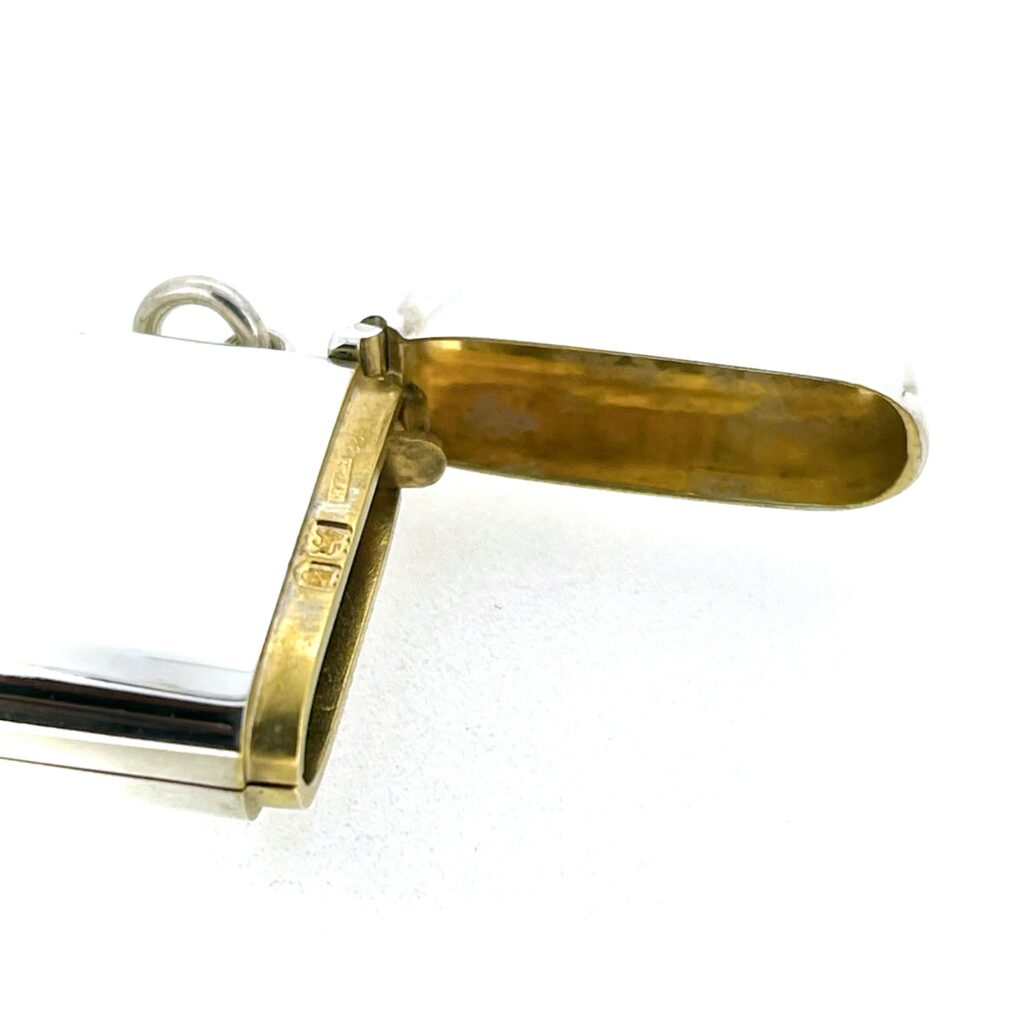
When acquired, the silver body was structurally excellent and fully functional. The hinge and sprung lid remained strong, while the original gilded interior survived to a substantial degree. The exterior carried a shallow historic dent, numerous scratches, striker wear, slight lid-corner wear and the minor marks expected from more than a century of handling.
The intention was not to erase that history or create the appearance of a newly manufactured replica. It was to return elegance and clarity to the object while preserving evidence of its age and use.
The silver exterior
The exterior was professionally polished to a high finish. Major visually distracting scratches were reduced, while finer evidence of age was deliberately retained.
One side carried a very shallow historic dent. Removing enough silver to eliminate every trace of it would have thinned the wall and altered the original geometry. The surface was therefore smoothed without sacrificing further historic material. A slight optical memory of the former impact remains visible under certain lighting.
Striker wear, minor handling marks and slight wear around the lid corners were also retained. These are not merely imperfections. They show that the case was carried, opened and used.
The gilt interior
The substantially surviving original gilding was preserved rather than stripped. A very thin modern layer of 18ct gold plating was applied over it to enrich the colour sympathetically and maintain the warm historic appearance of the match chamber.
This modern plating is part of the object’s restoration history and must remain permanently disclosed. It should not be confused with untouched original gilding. The underlying historic finish survives, but the visible surface has been deliberately modified.
Conservation rather than complete renovation
The most accurate description is “conservation-led restoration”. Original fabric, mechanisms, geometry and surviving gilding were preserved, but polishing and plating also served an aesthetic purpose. Calling the object untouched would be incorrect; calling the treatment a replacement would be equally misleading.
The case now appears clean, elegant and properly cared for while remaining unmistakably antique. Its retained marks form part of its biography, just as the documented modern treatment now forms part of its continuing provenance.
What Remains Unknown?
Research has established the object’s basic identity, documented its present minimum production period and placed it within a wider family of British and American concealed-photograph vestas. Several important questions remain unanswered:
- What exact product name and stock number did Mordan use?
- Did the design appear in the surviving 1898 catalogue?
- What was its original retail price?
- Was the mechanism patented, registered, licensed or supplied by another workshop?
- How closely do the internal mechanisms of the 1899, 1900 and 1902 Mordan examples correspond?
- What photographic process was originally intended?
- Was the portrait protected by glass, mica or another material?
- Who first owned the Vault example?
- How many further examples remain in private or institutional collections?
These questions do not weaken the object’s history. They define the next stage of it. A durable design archive should preserve uncertainty where evidence is incomplete and remain capable of absorbing new discoveries without silently rewriting earlier conclusions.
Why This Small Silver Case Matters
The historical importance of the design does not depend upon calling it unique.
Within a body only 50 mm high, it brings together several transformations taking place around the beginning of the twentieth century: the portability of fire, the growing accessibility of personal photography, the ritual of the gentleman’s pocket, precision manufacture in precious metal and the luxury trade’s fascination with ingenious combination objects.
Its emotional structure is equally important. The exterior is sober and practical. The interior is warm, private and sentimental. One function could be used in company; the other was revealed only by choice.
The case belongs simultaneously to the histories of silver, jewellery, photography, smoking accessories and portable design. It is a match container, a photograph locket and a chain accessory, but none of those descriptions is sufficient on its own.
Above all, it demonstrates one of the qualities that made S. Mordan & Co. distinctive: the ability to take a familiar personal possession and give it an additional life.
In this case, that second life was hidden in silver.
Research Conclusions
- The object is best identified as a combined sterling silver vesta case and concealed photograph frame.
- It was made under the historic S. Mordan & Co. name and hallmarked in London in 1902.
- Three individual Mordan examples are presently documented: silver cases from 1899 and 1902 and a 9ct gold case from 1900.
- The Mordan production period is therefore documented from at least 1899 to 1902.
- The gold example retains a baby portrait and a 1901 presentation inscription from Nell to Walter.
- Related hidden-photograph vestas were produced by several British and American makers between the late nineteenth and early twentieth centuries.
- No exact Mordan catalogue name, original retail price, patent or registered-design number has yet been established.
- A trimmed paper portrait is the leading interpretation for the original image, although a small tintype remains possible.
- The 1902 case has received fully documented conservation-led restoration and is offered for sale through the Sampson Mordan Vault. Its permanent Design Archive record will remain accessible after sale.
What is a vesta case?
A vesta case is a portable container made to carry loose matches. It normally includes a striking surface and a secure lid. In American collections, the same general object is often called a match safe.
Did this case hold a cardboard matchbox?
The sprung lid, internal chamber and striker wear indicate that it was probably intended to hold loose matches. “Matchbox holder” is understandable modern terminology, but vesta case is the more accurate functional description.
How was the photograph hidden?
A separate hinged silver panel opens to reveal a miniature photograph frame. The image was held behind a removable bezel and remained invisible while the case was closed.
What size photograph did it hold?
The visible aperture measures 22 × 17 mm. The complete photograph would have been slightly larger so that its edges could be retained beneath the bezel.
Was the photograph a tintype?
A small tintype is possible, but it has not been proved. A trimmed paper portrait is presently the leading interpretation, supported by the sepia photograph surviving within the closely related 1900 gold Mordan example.
Was the case intended for an Albert chain?
Its 10 mm suspension ring is compatible with an Albert chain, fob chain or another pocket attachment. No original catalogue image has yet been found to establish one exclusive method of wear.
How many Mordan examples survive?
Three individual examples have been identified in the records presently examined. This is a minimum documented census, not a claim that only three survive.
Did Sampson Mordan invent the hidden-photograph vesta?
There is currently no evidence proving that Mordan invented the type. Comparable British examples were produced by several makers from 1898 onwards, and related American match safes are also known.
Was the design patented?
No patent or registered-design number for the exact mechanism has yet been located. The relevant archival registers still require a detailed proprietor-name search, so the absence of a presently identified record does not prove that the design was unprotected.
Is the interior gilding original?
The original gilding survived substantially intact. A thin modern layer of 18ct gold plating was applied over it during conservation-led restoration. That intervention is permanently recorded as part of the object’s modern history.
Is the 1902 case available for sale?
Yes. This example is offered for sale through the Sampson Mordan Vault. Its research and Design Archive record will remain accessible after the physical piece passes into another collection.
Research Note
This article is based upon the examination and treatment record of the 1902 Vault object, surviving auction and dealer records for the 1899 and 1900 Mordan examples, documented comparisons by other British and American makers, museum collection records and specialist photographic and conservation references.
The surviving-object census records individual objects rather than webpages. Where the same gold case appeared in both a dealer archive and a later auction, it has been counted once. Archive searches and the census will be updated as new evidence becomes available.

Recent Comments