Sampson Mordan Hallmarks
Hallmarks are one of the most important forms of evidence in British jewellery and silver. They can help identify precious metal, fineness, assay office, date and, in many cases, the maker or sponsor responsible for submitting an article for assay.
This page explains British hallmarking, records known historic Sampson Mordan marks and provides a growing visual reference for collectors, clients and researchers.
The Sampson Mordan Hallmark Catalogue will continue to expand as further verified pieces are acquired, photographed and documented through The Vault.
UK Hallmarking and the Dealer’s Notice
UK hallmarking exists to protect buyers of precious metal articles. A hallmark provides independent evidence that an article has been tested and meets a recognised standard of precious metal fineness.
Dealers supplying precious metal items are required to display the official Dealer’s Notice explaining approved hallmarks. For online sales, appropriate hallmarking information should be made available at the virtual point of sale.
Dealer’s Notice
Where applicable, Sampson Mordan & Co.® precious metal pieces are described and sold in accordance with UK hallmarking requirements.
Precious Metal Exemption Weights
Some precious metal articles fall below the statutory weight at which compulsory hallmarking applies.
Silver
Below 7.78 grams.
Gold
Below 1.0 gram.
Platinum
Below 0.5 grams.
Palladium
Below 1.0 gram.
Articles above the relevant exemption weight generally require an approved hallmark if they are described and sold as precious metal, unless another legal exemption applies.
A piece falling below an exemption weight may still carry a hallmark. Historic makers frequently submitted smaller articles for assay, meaning surviving pieces can provide valuable hallmark evidence even where their weight would not necessarily have required compulsory hallmarking.
How to Read a British Hallmark
A British hallmark can consist of several separate marks. Read together, they can reveal important information about an article.
[IMAGE: Labelled British hallmark showing the principal components]
Sponsor’s Mark or Maker’s Mark
The registered mark associated with the person or business responsible for submitting the article for assay.
On historic pieces, this can provide important evidence connecting an article with Sampson Mordan, S. Mordan & Co. or another associated business.
Fineness Mark
The fineness mark identifies the standard of precious metal, such as sterling silver or a recognised standard of gold, platinum or palladium.
[IMAGE: Traditional fineness symbols]
[IMAGE: Millesimal fineness marks]
Assay Office Mark
The assay office mark identifies the office at which the article was tested and marked.
[IMAGE: British assay office marks]
Date Letter
A date letter may identify the hallmarking year when interpreted according to the correct assay office and date-letter cycle.
[IMAGE: Date letter reference]
Traditional Fineness Symbols
Traditional symbols may appear alongside other hallmark components depending on the precious metal, date and marking convention.
Duty Marks
Certain historic British precious metal articles carry a sovereign’s head or other duty mark indicating that the appropriate duty had been paid. These belong to particular historical periods and can provide additional dating evidence.
Hallmarks, Maker’s Marks, Patent Marks and Retailer’s Marks
Not every mark found on a Sampson Mordan piece is a hallmark. Understanding the distinction between different forms of marking is essential when identifying and dating historic pieces.
Hallmark
The legally recognised group of assay marks applied to a precious metal article.
Maker’s Mark or Sponsor’s Mark
The registered mark associated with the maker or with the person or business responsible for submitting the article for assay.
A sponsor’s mark identifies the party responsible for submission. It should not automatically be interpreted as proof that every component of an article was physically manufactured by that party.
Patent Mark
A stamp, inscription or number relating to a patented invention, mechanism or improvement. Patent information can be particularly important when researching Sampson Mordan mechanical pencils and other inventive forms.
Registered Design Mark
A mark indicating registered design protection. This may include Victorian registration lozenges or later registered design numbers.
Retailer’s Mark
The name or stamp of a retailer through whom an article was sold. A retailer’s name is not necessarily the name of the manufacturer.
This distinction is particularly important when studying Sampson Mordan pieces. Pencils, cases, seals, postal scales, sovereign cases, desk pieces and gentlemen’s accessories may carry different combinations of hallmarks, patent marks, registered design marks, retailer inscriptions and other stamps.
Historic Sampson Mordan Maker’s and Sponsor’s Marks
Sampson Mordan and later S. Mordan & Co. used a number of recorded marks during the nineteenth and early twentieth centuries.
Their form may vary according to date, partnership, assay office, registration and the type of article being marked.
The entries below form a working chronological reference rather than a closed list. They will be expanded and refined as further documentary evidence and verified pieces become available.
Where suitable examples are available, individual entries can include a close-up photograph of the maker’s or sponsor’s mark, the complete hallmark, the complete piece, assay office information, date-letter interpretation and notes on attribution.
1823 — SM
Recorded mark: SM
An early mark associated with Sampson Mordan.
The standalone initials are particularly significant when studying the earliest period of the Mordan business and should always be interpreted alongside the complete hallmark and the characteristics of the article on which they appear.
Catalogue status: Historic reference entry. Further verified photographed examples to be documented.
[IMAGE: Close-up of SM mark]
[IMAGE: Complete hallmark]
[IMAGE: Complete object]
1824–1836 — Sampson Mordan and Gabriel Riddle
Recorded marks: SMGR / SM.GR variants
Marks associated with the partnership period of Sampson Mordan and Gabriel Riddle are important evidence for pieces connected with this early chapter of the business.
The precise form, date and context of individual marks should be established from verified examples and contemporary registration evidence.
Period: 1824–1836 partnership era.
Catalogue status: Verified examples to be added as documented.
[IMAGE: Close-up of partnership mark]
[IMAGE: Complete hallmark]
[IMAGE: Complete object]
1843 — SM
Recorded mark: SM
A later Sampson Mordan mark is recorded in silver-mark references for this period.
Because identical or similar initials may occur in different registrations and periods, attribution should be based on the complete hallmark and supporting evidence rather than the initials alone.
Catalogue status: Reference entry pending a suitable verified photographic example.
[IMAGE: Close-up of mark]
[IMAGE: Complete hallmark]
[IMAGE: Complete object]
1880 — S.M & Co. Variant
Recorded mark: S.M & Co. / S.M&Co variant
A later nineteenth-century form associated with S. Mordan & Co.
Surviving examples may show differences in punctuation, spacing and the form of individual letters. These details can be useful when comparing marks from different registrations and periods.
Catalogue status: Photographic examples to be catalogued.
[IMAGE: Close-up of mark]
[IMAGE: Complete hallmark]
[IMAGE: Complete object]
1889 — S. Mordan & Co. Chester Variant
A mark associated with S. Mordan & Co. was registered for use on Chester-assayed pieces.
Chester hallmarks are particularly useful because the assay office mark and date letter can help place an article within a more precise historical context.
Assay office: Chester.
Catalogue status: Full verified examples to be documented.
[IMAGE: Close-up of S. Mordan & Co. mark]
[IMAGE: Complete Chester hallmark]
[IMAGE: Complete object]
1890 — S. Mordan & Co. Variant
A further later nineteenth-century registered form is recorded for S. Mordan & Co.
Differences in lettering, punctuation, framing and striking should be photographed carefully rather than treated as interchangeable.
Catalogue status: Verified examples to be added.
[IMAGE: Close-up of mark]
[IMAGE: Complete hallmark]
[IMAGE: Complete object]
1902 — SM&Co
Recorded mark: SM&Co
A London mark in this form is recorded in silver-mark references from the early twentieth century.
The mark should be interpreted with the assay office symbol, date letter and other components of the complete hallmark.
Assay office: London reference recorded.
Catalogue status: Image verification required before establishment as a fully photographed catalogue entry.
[IMAGE: Close-up of SM&Co mark]
[IMAGE: Complete London hallmark]
[IMAGE: Complete object]
1904 — SM&Co / S. Mordan & Co. Variant
Early twentieth-century pieces may carry forms of the S. Mordan & Co. mark associated with the later company period.
Minor variations between punches should be documented separately wherever sufficient evidence exists rather than grouped together solely because they use similar initials.
Catalogue status: Verified examples to be photographed and compared.
[IMAGE: Close-up of mark]
[IMAGE: Complete hallmark]
[IMAGE: Complete object]
1905–1909 — Further SM&Co Variants
Further related marks are recorded during the early twentieth century.
As suitable pieces are acquired and researched, individual years and punch variants can be given their own catalogue entries rather than being combined into a single generic identification.
This allows the reference to develop chronologically as new evidence becomes available.
Catalogue status: Further research and verified objects required
1906 — SM&Co Variant
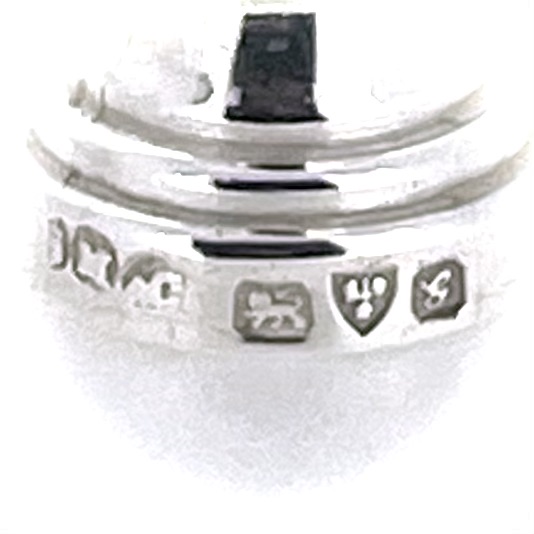
Some references record a distinctive form of the SM&Co mark from this period, including a small line or feature beneath the “o” of “Co”.
Small typographic differences can be valuable when distinguishing one registered punch from another and should therefore be documented at high magnification wherever possible.
Catalogue status: Close photographic verification required.
[IMAGE: Macro photograph of maker’s mark]
[IMAGE: Complete hallmark]
[IMAGE: Complete object]
Assay Offices Found on Sampson Mordan Pieces
Sampson Mordan and S. Mordan & Co. pieces can be found with hallmarks from different British assay offices.
The assay office mark is separate from the maker’s or sponsor’s mark and forms an important part of the complete hallmark.
London
London was central to the history of Sampson Mordan and is one of the principal assay offices encountered on Mordan silver.
[IMAGE: London assay office mark]
[IMAGE: Verified Sampson Mordan London hallmark]
Chester
Chester hallmarks are found on historic S. Mordan & Co. pieces and can provide particularly useful dating evidence.
[IMAGE: Chester assay office mark]
[IMAGE: Verified S. Mordan & Co. Chester hallmark]
Birmingham
Birmingham-assayed examples should be documented individually as verified pieces enter the archive.
[IMAGE: Birmingham assay office mark]
[IMAGE: Verified example]
Sheffield
Sheffield examples will be added where supported by clearly documented pieces and complete hallmarks.
[IMAGE: Sheffield assay office mark]
[IMAGE: Verified example]
Further assay offices should be added to this reference only where reliable examples or documentary evidence support their inclusion.
Date Letters and Dating Sampson Mordan Pieces
Date letters can help identify the year in which a precious metal article was assayed, but they must be interpreted carefully.
- The assay office.
- The style of lettering.
- The shape of the surrounding punch.
- Uppercase or lowercase form.
- The relevant date-letter cycle.
[IMAGE: Date letter comparison]
On antique pieces, marks may also be rubbed, partially struck, distorted by use or softened through repeated polishing.
For a Sampson Mordan piece, a date letter should therefore be considered alongside the maker’s or sponsor’s mark, assay office, metal and fineness marks, object type, construction, mechanism, patent information, registered design information, engraving, stylistic evidence and provenance where available.
A date letter is powerful evidence, but it should form part of the wider identification of the piece rather than being read in isolation.
Registered Designs, Patent Marks and Other Stamps
Sampson Mordan’s history extends well beyond conventional silversmithing. The business became closely associated with invention, mechanical ingenuity and registered designs, particularly through writing instruments and other personal and domestic articles.
For this reason, markings beyond the hallmark can be extremely useful.
Victorian Registered Design Marks
Victorian registration lozenges can provide evidence relating to the registration date and classification of a design.
[IMAGE: Sampson Mordan registered design lozenge]
Registered Design Numbers
Later objects may carry numerical registered design references rather than lozenge marks.
[IMAGE: Registered design number example]
Patent Marks
Patent inscriptions and numbers may help identify patented mechanisms, improvements and particular forms. These can be especially valuable when researching mechanical pencils and other inventive Mordan designs.
[IMAGE: Sampson Mordan patent mark]
Retailer and Trade Marks
Some articles may carry the name of the retailer through whom they were sold. These marks can provide useful provenance and evidence of historic commercial relationships, but they should not automatically be interpreted as the identity of the manufacturer.
[IMAGE: Retailer-marked Sampson Mordan example]
Reading Marks on Vintage and Antique Pieces
Vintage and antique Sampson Mordan pieces do not always present perfect hallmarks.
- Clear and deeply struck.
- Partially struck.
- Rubbed through use.
- Softened by historic polishing.
- Distorted by the shape of the article.
- Hidden within a mechanism or fitting.
- Affected by repair or alteration.
Some pieces may also contain replacement parts, later chains, altered fittings or repaired components.
Attribution should therefore not depend on a single indistinct stamp where the wider evidence is uncertain.
A careful assessment considers the whole piece: marks, construction, material, form, mechanism, design, finish, condition and provenance.
Where uncertainty remains, the catalogue should record that uncertainty rather than force a definitive attribution.
Modern Sampson Mordan & Co. Hallmarking
Present-day Sampson Mordan & Co.® precious metal pieces will be described and hallmarked in accordance with applicable UK hallmarking law.
Where an article falls below the relevant statutory exemption weight, hallmarking requirements will be considered according to the metal, weight and manner in which the article is described and offered for sale.
Where compulsory hallmarking applies, the appropriate approved hallmark will be used.
As new Sampson Mordan & Co. pieces are created, this page can also become the permanent record of the house’s present-day hallmarking.
- The Sampson Mordan & Co. sponsor’s mark.
- Assay office arrangements.
- Precious metal standards.
- Hallmark placement.
- Commemorative marks.
- Special assay marks.
- Examples from individual collections.
[IMAGE: Modern Sampson Mordan & Co. hallmark when available]
The Sampson Mordan Hallmark Catalogue
The Sampson Mordan Hallmark Catalogue records marks documented from verified objects, archive material, reliable references and pieces handled directly by Sampson Mordan & Co.
Its purpose is to build a visual research resource rather than simply reproduce lists of initials and dates.
Hallmarks may vary according to date, assay office, registered punch, object type, position of the mark, method of striking, wear, polishing, repair and distortion caused by the form of the article.
For that reason, photographed examples are especially valuable.
As The Vault grows, individual pieces can be added as complete catalogue records.
Sampson Mordan & Co. Chester 1900 Sterling Silver Sovereign Case
[IMAGE: Complete object]
[IMAGE: Close-up of S. Mordan & Co. maker’s mark]
[IMAGE: Complete hallmark row]
Maker’s or sponsor’s mark: S. Mordan & Co.
Mark type: Maker’s mark / sponsor’s mark.
Assay office: Chester.
Date letter: R.
Hallmark date: 1900.
Metal: Sterling silver.
Object type: Sovereign case.
Description: Spiral-fluted sovereign case with suspension loop.
Condition of marks: [Add following examination]
Catalogue status: To be completed with verified photographs and full object examination.
Research notes: [Add attribution, provenance, construction, repair or other relevant observations]
Future Hallmark Catalogue Entries
Future catalogue entries may document Sampson Mordan marks found on propelling pencils and writing instruments, seals, desk seals, fob seals, sovereign cases, scent bottles, vinaigrettes, card cases, boxes, postage and letter scales, desk accessories, gentlemen’s accessories, chains, fobs, jewellery, gold and silver smallwork, registered designs and patented objects.
Each significant mark or newly verified date can be given its own individual section, allowing photographs, detailed observations and new research to be added without altering the wider structure of the page.
Over time, this will allow the catalogue to develop into a chronological visual record of Sampson Mordan marks from the earliest documented period through S. Mordan & Co. and into the present-day Sampson Mordan & Co. house.
Submitting a Sampson Mordan Hallmark
If you own a Sampson Mordan, S. Mordan & Co. or related piece carrying clear hallmarks, patent marks or registered design marks, we welcome carefully photographed information for research consideration.
Useful photographs include the complete piece, a close-up of the maker’s or sponsor’s mark, the complete hallmark, any date letter, patent marks or numbers, registered design marks, retailer inscriptions and identifying engraving.
Where available, provenance, purchase history and other supporting information may also be useful.
We cannot authenticate an article from photographs alone. However, submitted information may contribute to wider research and to the continuing development of the Sampson Mordan Hallmark Catalogue.
For research enquiries, please visit our Contact page.
Further Reading
GOV.UK
Hallmarking guidance and information on how businesses can comply with hallmarking law.
British Hallmarking Council
Official hallmarking guidance and the current Dealer’s Notice.
The Goldsmiths’ Company Assay Office, London
Information on historic and modern hallmarking, assay marks and precious metal standards.
A Growing Reference
The Sampson Mordan Hallmark Catalogue is intended to grow piece by piece.
Every clearly documented hallmark adds another fragment to the history of the house: a date, a registered punch, an assay office, a material, an article and the people who made, sold, owned and preserved it.
As further pieces enter The Vault and the archive, new marks and dates will be photographed, researched and added to this reference.
