In 1822, John Isaac Hawkins and Sampson Mordan secured one of the defining patents in the history of portable writing instruments. It is usually remembered as the patent behind the Mordan propelling pencil. The surviving specification tells a broader and more interesting story.
Patent No. 4742 concerned improvements to pencil holders, then commonly described as port crayons, and to pens. Its purpose was to reduce the repeated cutting, sharpening and repair normally required as writing points wore down. The document therefore joined two related problems: how to advance a pencil or crayon as it shortened, and how to make a pen nib last longer.
The pencil made the Mordan name famous. Patent No. 4742 shows that the original programme of invention extended beyond the pencil alone.
Hawkins and Mordan in 1822
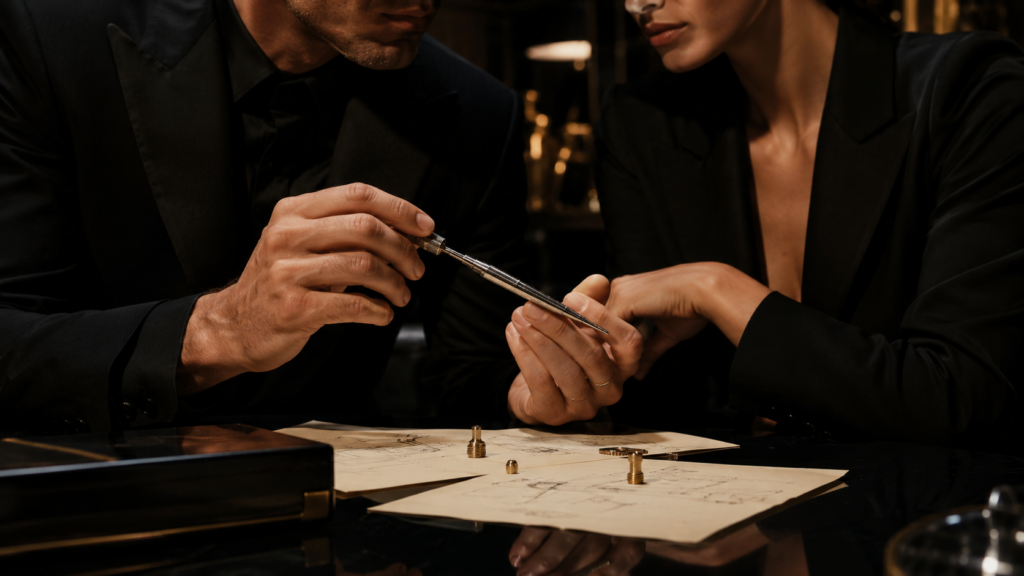
The surviving royal document identifies John Isaac Hawkins of Pentonville as a civil engineer and Sampson Mordan of Union Street, City Road, as a portable pen maker.
That description of Mordan matters. It comes from the moment of the invention itself, before the later fame of S. Mordan & Co. had settled around silver propelling pencils and a much wider range of personal objects. In 1822, Mordan was already working at the meeting point of writing, metalwork, portability and mechanism.
Hawkins brought the restless range of a prolific engineer and inventor. Mordan brought a practical understanding of small writing instruments and their manufacture. Patent No. 4742 was granted to them jointly, and its language repeatedly speaks in the plural: the mechanisms, materials and methods are presented as their shared invention.
This makes the patent an important threshold in the Sampson Mordan story. It stands between Mordan’s formative world of precision engineering and the recognisable commercial identity that followed.
The Date of Patent No. 4742

The surviving royal warrant is dated 21 November 1822. Signed under George IV and carrying the signature of Home Secretary Robert Peel, it authorised the preparation of letters patent for Hawkins and Mordan.
The patent is recorded under 20 December 1822, the date conventionally associated with Patent No. 4742. The inventors were granted exclusive benefit of the invention for fourteen years, subject to the required detailed specification being enrolled.
The full specification was later printed in the April 1826 issue of The Repertory of Patent Inventions, accompanied by a plate illustrating the pencil mechanisms and pen constructions.
These dates describe different stages of the same legal and technical record. The November document is the surviving royal authority; 20 December is the patent date by which the invention is generally catalogued; and the 1826 printing made the detailed specification more widely accessible.
Why the Correct Patent Number Matters
The correct number is 4742.
The number **4722** appears in some modern accounts, but it does not identify the Hawkins and Mordan writing-instrument patent. Repeating that error weakens the historical record and makes the original specification harder to locate.
Patent No. 4742 should therefore be used consistently across the Sampson Mordan Design Archive, the history of the house and future writing-instrument research.
What Was a Port Crayon?

A port crayon was a holder for a pencil, crayon or similar drawing material. Rather than being discarded as its writing point shortened, the material was supported within a reusable body and advanced when required.
This was a practical object, but it was also a precision instrument. The holder had to grip the writing material securely, present it steadily to the hand and allow more of it to emerge without splitting or slipping. Its internal parts had to operate within a body small enough to carry in a pocket, case or writing set.
The 1822 specification addressed these demands through several related arrangements rather than a single fixed design.
The Screw Driven Pencil Holder
The best-known arrangement used a nozzle to hold the pencil or crayon and an internal screw-driven component to advance it. Turning the outer body moved the driver lengthwise, forcing the writing material forward as its point wore down.
In a more developed version, the mechanism could also draw the pencil back into the holder. The writing material could be attached to the driver by a screw or held by a split elastic end that embraced it.
This distinction is important. The invention was not merely a decorative tube surrounding a short length of graphite. Its component parts controlled the position of the writing material and allowed the usable point to be renewed mechanically.
The specification also describes a wrapping of silk or another elastic material used to introduce light friction and prevent the outer tube from turning too freely. It is a small detail, but it demonstrates the care given to feel, resistance and control in the finished instrument.
Several Mechanisms Rather Than One Pencil
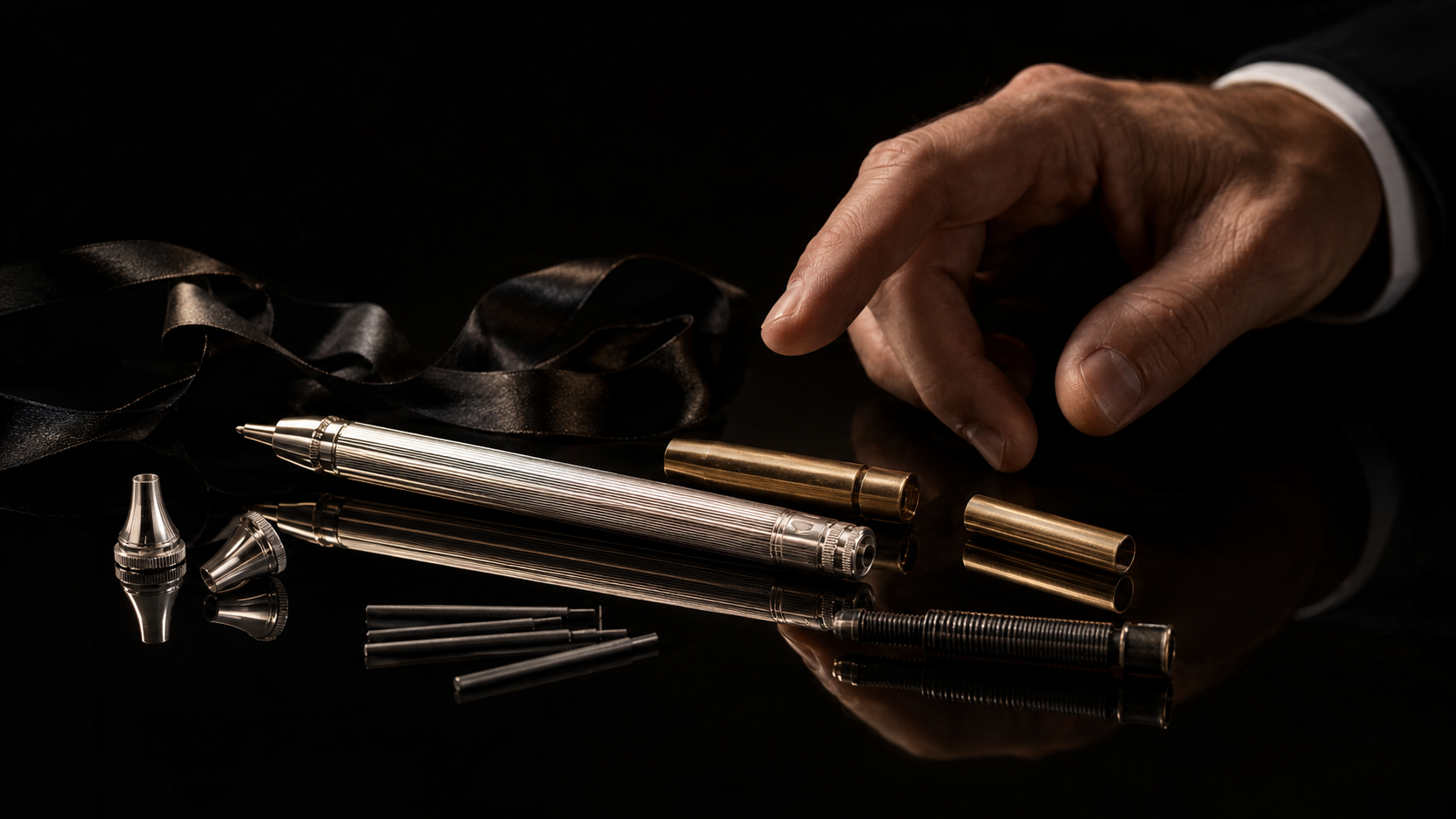
Patent No. 4742 did not stop with the best-known screw mechanism.
The specification described interchangeable nozzles in different sizes so that one handle could accommodate different pencils or crayons. Another arrangement allowed a reserve of six short leads to be stored within the body, ready to replace the piece in use. Simpler constructions were proposed for longer pencils, including a sliding driver controlled by a milled nut.
The inventors deliberately avoided prescribing a single scale. They understood that artists and writers might require anything from a broad crayon to an extremely fine point. The dimensions of the holder therefore depended upon the writing material and the work for which it was intended.
This is less the description of one finished retail model than a family of solutions. The patent established principles that could be adapted across sizes, materials and forms.
Precious Materials and Practical Manufacture
Gold and silver appear naturally within the specification, alongside brass, steel and other working metals. The visible body could also be formed or covered in ivory, tortoiseshell or another suitable material.
That breadth helps explain why the Mordan pencil could move so easily between tool and personal possession. Its mechanism belonged to practical manufacture; its exterior could belong to the worlds of silver, jewellery, gifting and dress.
Later Mordan writing instruments survive in many forms because this combination proved so fertile. A pencil could be technically serious and visually refined. It could be carried, worn on a chain, included in a fitted case or made as a precious object in its own right.
This relationship between engineering and beauty remains central to understanding what Sampson Mordan made.
The Forgotten Half of the Patent
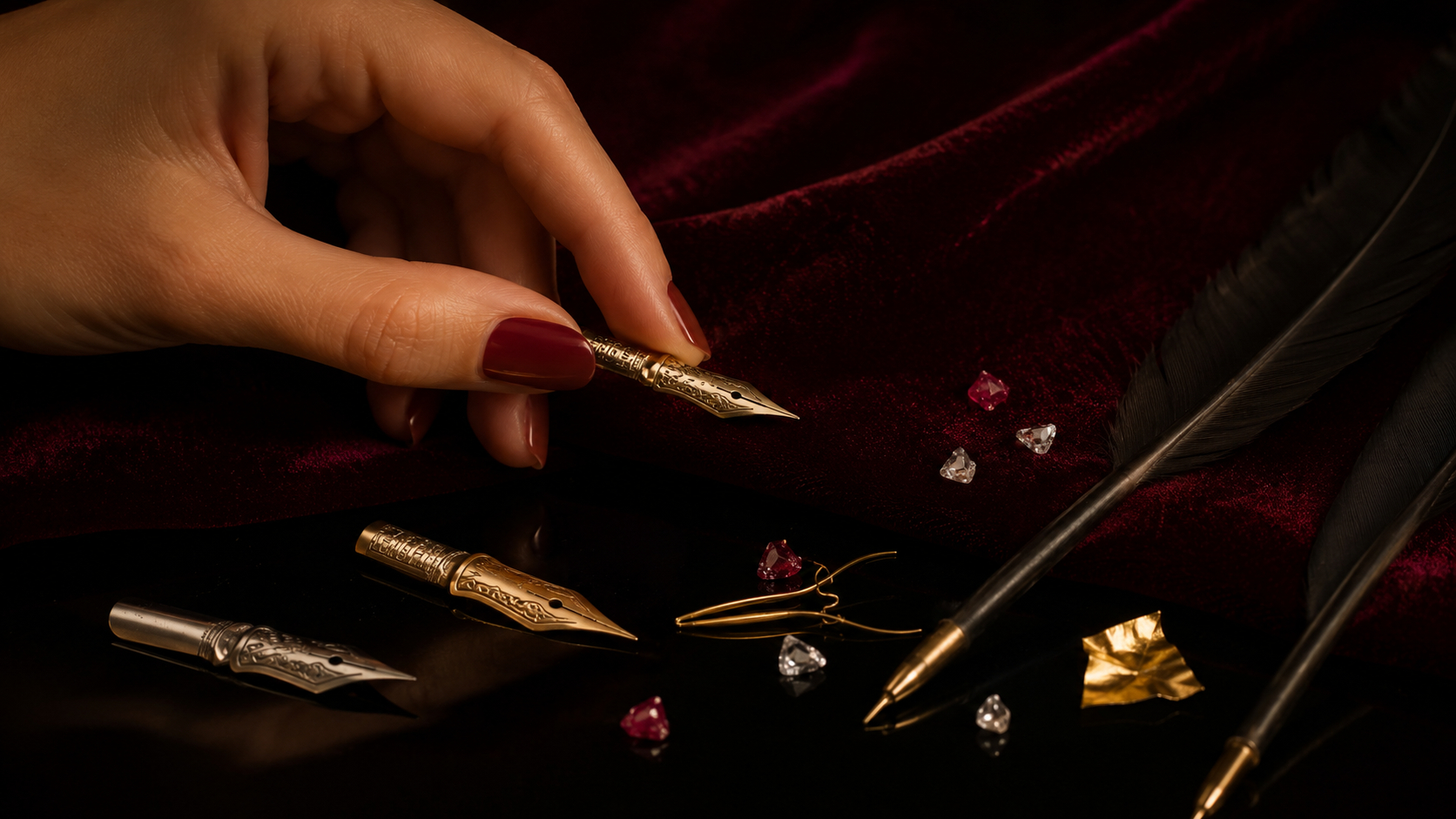
The second half of Patent No. 4742 concerned pens.
Hawkins and Mordan were trying to reduce the need to cut or mend a nib repeatedly as it wore. Their specification explored several ways to strengthen the writing points of pens made from tortoiseshell, horn or quill.
Some methods involved introducing very hard materials such as particles or pieces of diamond or ruby into the wearing parts of the nib. Another proposed wrapping thin sheet gold around the end of tortoiseshell before shaping the two materials together. Further methods used non-corroding cement or varnish to secure hard particles at the writing points.
The specification also described a sliding forked spring placed against the back of a pen. By changing its position, the writer could alter the stiffness of the nibs. Related arrangements incorporated the spring into a portable pen holder.
These proposals reveal the patent’s unifying idea. Whether the instrument used graphite, crayon or ink, its writing point should remain useful for longer and require less frequent manual repair.
A Patent for Writing Rather Than Pencils Alone
Patent No. 4742 is often reduced to a single sentence: Hawkins and Mordan patented the mechanical pencil in 1822. That summary is useful, but incomplete.
The document was concerned with the durability, renewal and control of writing points. Its pencil mechanisms advanced material as it was consumed. Its pen proposals attempted to protect or reinforce the parts exposed to wear. Both belonged to the same ambition: to make writing and drawing more continuous, portable and precise.
This broader reading also restores Hawkins to the account. The patent was joint, and the full specification reflects a range of engineering and writing-instrument concerns wider than the later commercial identity of the Mordan pencil.
Was It the First Mechanical Pencil?
Earlier refillable pencils and lead holders are known to have existed. Patent No. 4742 should not be used to suggest that no mechanical or replaceable pencil had ever been made before 1822.
Its importance is more precise. Hawkins and Mordan secured the foundational British patent most closely associated with the internally propelled metal pencil, and they described its construction in exceptional practical detail. The screw-driven mechanism allowed the writing material to be advanced deliberately as it wore, distinguishing it from simpler holders that merely gripped a fixed piece of lead.
It is therefore reasonable to describe Patent No. 4742 as a landmark in the history of the mechanical pencil, while recognising that the history of refillable writing instruments began earlier.
From Patent to the Mordan Name
The patent preceded the earliest currently identified London directory listing for S. Mordan & Co. and the mature public identity of the business. It also preceded the long sequence of Mordan pencils, pens, cases and precious writing instruments now sought by collectors.
In 1823, Mordan entered an SM mark at the London Assay Office as a smallworker. Surviving objects and later trade records then reveal the expansion of a business capable of translating mechanism into silver and gold.
Patent No. 4742 did not by itself create everything that followed. It did, however, establish the combination that would define the name: useful invention made portable, personal and precious.
The Sampson Mordan hallmark record and the developing Design Archive allow that story to be traced through the surviving pieces themselves.
Why Patent No. 4742 Still Matters
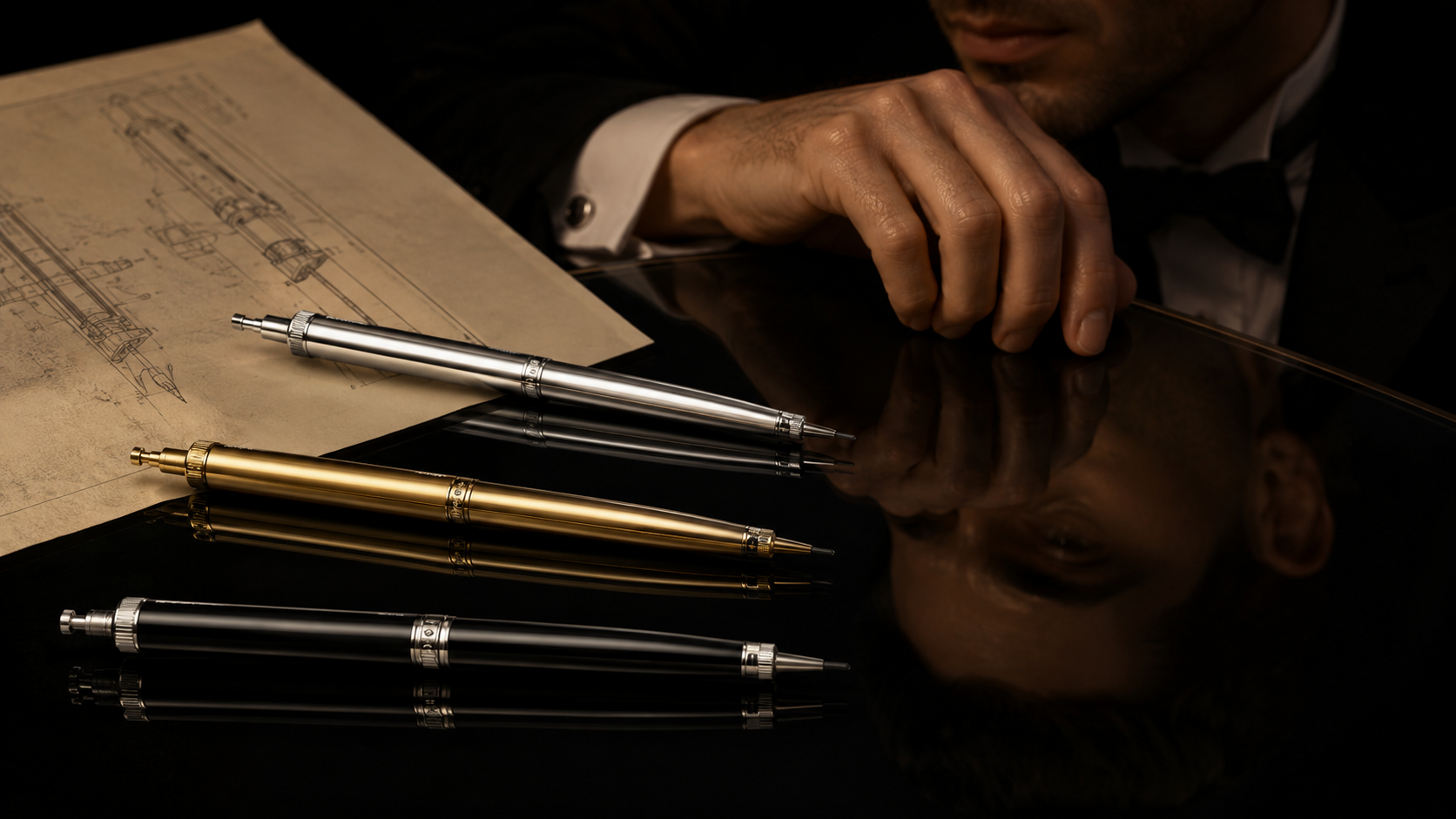
The patent matters because it records a way of thinking.
Hawkins and Mordan did not treat wear as an unavoidable inconvenience. They examined how a pencil shortened, how a nib failed, how friction felt in the hand, how different materials behaved and how one mechanism might serve several scales of work.
The result connected engineering with everyday ritual. Writing was made easier not through spectacle, but through small improvements hidden within an object held in the hand.
That principle reaches far beyond the propelling pencil. It can be seen throughout the surviving Mordan world: concealed mechanisms, secure compartments, sprung lids, fitted cases, chain-worn objects and pieces in which practical purpose is inseparable from form.
Patent No. 4742 is therefore more than the beginning of a famous pencil. It is an early statement of the design intelligence that made the Sampson Mordan name endure.
Frequently Asked Questions
What was Sampson Mordan Patent No. 4742?
Patent No. 4742 was granted jointly to John Isaac Hawkins and Sampson Mordan in 1822. It covered improvements to pencil holders or port crayons and to pens, with the aim of reducing the need to sharpen, cut or repair their writing points repeatedly.
What is the correct number of the 1822 Hawkins and Mordan patent?
The correct number is 4742. The number 4722 appears in some later accounts but does not identify this patent.
When was Patent No. 4742 granted?
The surviving royal warrant is dated 21 November 1822, while the patent is recorded under 20 December 1822. The detailed specification was later printed in April 1826.
Did the patent cover only a mechanical pencil?
No. It described several pencil-holder mechanisms as well as methods intended to make pen nibs more durable and adjustable.
Who was John Isaac Hawkins?
John Isaac Hawkins was a civil engineer and prolific inventor. Patent No. 4742 was granted to Hawkins and Mordan jointly, and both men should be credited in accounts of the invention.
Was Patent No. 4742 the first mechanical pencil?
Earlier refillable pencils and lead holders existed. Patent No. 4742 is best understood as the foundational British patent associated with the internally propelled metal pencil, rather than proof that no mechanical pencil of any kind had existed before it.

Recent Comments